This beautifully neat solution was sent in by Johnny Chen.
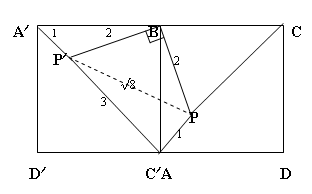
If we rotate the figure by 90 degrees about B (clockwise). This
should result in a new square A¢BC¢D¢ with a point P¢ inside
the new square such that, ÐPBP¢=90o and BP=BP¢=2. By
Pythagoras, PP¢ = Ö8. Now consider triangle AP¢P. The side
lengths are 3, Ö8, and 1which satisfies Pythagoras again:
32 - 12 = (Ö8)2.
So this triangle has 90 degrees at ÐP¢PA. Since we know
that ÐBPP¢=45o therefore ÐBPA is 135 degrees.
This alternative method comes from Yatir from Maccabim-Reut
High School, Israel.
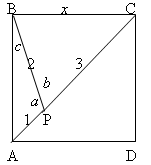
AB=BC=CD=AD=x, BP=2, CP=3, AP=1. Name the angles this
way: ÐABP = c, ÐCBP = 90-c, ÐAPB = a,
ÐCPB = b.
We need to find angle a. By the Sine Law:
|
|
x
sinb
|
= |
3
sin(90-c)
|
= |
3
cosc
|
|
|
and
Hence sinc = sina /x, cosc = 3sinb /x and we use the
identity sin2 c + cos2 c = 1 to eliminate c.
So
|
sin2 (a/x2) + 9sin2 (b / x2) |
|
| |
|
|
Using the Cosine Law we find cosb and then eliminate b:
so
Using the identity sin2 b + cos2 b = 1 we get
|
(x2 - sin2 a)/9 + [(13 - x2)2]/144 = 1 (1). |
|
Finally we eliminate x. By the Cosine Law x2 = 4 + 1 - 4cos a so
Combine (1) and (2) and simplify and we get:
hence cos2 a = 1/2.
This yields solutions: a=45 or a=135 degrees.
Now this angle cannot be 45 degrees because angle c is smaller
(AP is the shortest side of triangle APB) and the third angle
of the triangle is less than 90 degrees. Hence angle a is 135
degrees.