If I gave you a list of decimals, you might find it quite
straightforward to put them in order of size. But what about
ordering fractions?
A man called John Farey investigated sequences of fractions in
order of size - they are called Farey Sequences.
The third Farey Sequence, $F_3$, looks like this:
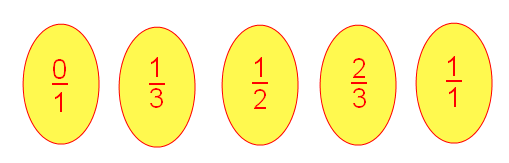
It lists in order all the fractions between $0$ and $1$, in
their simplest forms, with denominators up to and including
$3$.
Here is $F_4$:
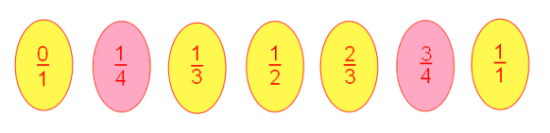
Write down $F_5$.
Which extra fractions are in $F_5$ which weren't in
$F_4$?
Use $F_5$ to help you complete $F_6$ and $F_7$.
Here are some questions to
consider:
There are lots of extra fractions in $F_{11}$ which are not in
$F_{10}$.
There are only a few extra fractions in $F_{12}$ which are not
in $F_{11}$.
Can you explain why this is the case?
When will you need lots of extra fractions to get the next
Farey Sequence?
Will every Farey Sequence be longer than the one before? How do
you know?
So far, all the Farey Sequences have contained an odd number of
fractions. Can you find a Farey Sequence with an even number of
fractions?
In $F_4$, $\frac{3}{4}$ slotted in between $\frac{2}{3}$ and
$\frac{1}{1}$. What do you notice about the fractions on either
side when you slot in a new fraction?
Choose any three consecutive fractions from a Farey Sequence.
Can you find a way to combine the two outer fractions to make
the middle one?
To see how these sequences
relate to some beautiful mathematical patterns see the pictures
in the problem Ford
Circles. There is no need
to attempt this problem at this stage - it is aimed at older
students.