Why do this problem?
This problem offers the opportunity to practise the important
skill of ordering fractions while investigating and making
conjectures about an intriguing sequence of sequences. There is
a chance to work on a variety of questions at different
levels.
Possible approach
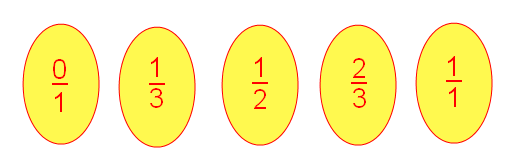
"This is the third Farey sequence. Can you work out what
rules have been used to generate it?"
Once students have identified all the criteria, ask them to
discuss with their partner what they think the fourth Farey
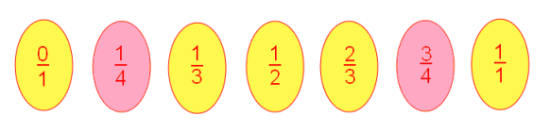
Sequence will look like. Then show them the
fourth sequence. Perhaps
clarify the rule about equivalent fractions by asking "Where
is $\frac{2}{4}$?"
Write up $F_2, F_3,$ and $F_4$ on the board, and challenge
students to work out $F_5, F_6,$ and $F_7$, using the agreed
rules, and think about what they will do next:
"When you've finished, I'll be asking you to investigate
these sequences, so think about questions you would like to
ask and things that you notice while you are working."
As students are working on the sequences, circulate to see if
everyone is getting the same results. If so, when the class
is ready to move on write the agreed results for $F_5, F_6,$
and $F_7$ on the board. If not, ask students with differing
answers to write their sequences on the board, and ask the
class for their comments. When consensus is reached, move on:
"Mathematicians often look for patterns to help them to
understand something better. What might mathematicians notice
about the Farey Sequences we have found? What questions might
they want to explore next?"
Take suggestions from the class and list them on the board.
There are some "questions to consider" at the bottom of the
problem which could be used to supplement the class's
suggestions.
Allow the students to choose what they would like to explore.
They may wish to work with a partner. One nice way to feed
back at the end of this activity is for each student to work
on paper and for findings on similar conjectures to be
displayed together on a noticeboard.
Key questions
When is $\frac{a}{b}< \frac{c}{d}$?
Possible
extension
Can you find an example where you put in an odd number of
fractions to get the next Farey Sequence? If not, why not?
Possible support
Students need to be confident at comparing fractions by using
equivalent fractions. One way of supporting them in this is to
use a fraction
wall.