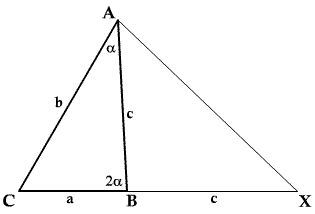
First you have to prove the identity for such triangles. It can be proved using the similar triangles in the diagram or alternatively from the Sine and Cosine Rules. Method 1 By construction is an isosceles triangle. The angle of this triangle at is , and hence the angles at and are . Therefore and are similar; hence
| u | v | a | b | c | |||
| 2 | 3 | 4 | 6 | 5 | |||
| 3 | 4 | 9 | 12 | 7 | |||
| 3 | 5 | 9 | 15 | 16 | |||
| 4 | 5 | 16 | 20 | 9 |
Note: it can be proved that , and give a triangle if and only if ; see Math. Gazette, Vol. 412, June 1976, p.130.