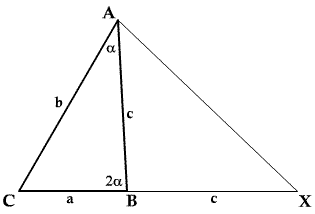
First you have to prove the identity b2 = a2 +ac for such triangles. It can be proved using the similar triangles in the diagram or alternatively from the Sine and Cosine Rules.

Method 1 By construction ΔABX is an isosceles triangle. The angle of this triangle at B is 180 -2α, and hence the angles at A and X are α. Therefore ΔXAC and ΔABC are similar; hence
a b = BC AC = AC XC = b a+c ,

and thus b2 = a2 +ac.

Method 2 By the Cosine Rule:
b2 = a2 + c2 -2accos2α a2 = b2 + c2 -2bccosα

Subtracting the equations, using the double angle formula and rearranging them a bit we get :
2 b2 -2 a2 =2c(bcosα-a cos2 α+a).   (1)

By the Sine Rule:
a sinα = b sin2α a sinα = b 2sinαcosα cosα = b 2a .   (2)

Combining (1) and (2):
2 b2 -2 a2 =2c( b2 2a - 2 ab2 4 a2 +a) =2c( b2 2a - b2 2a +a) b2 - a2 =ca b2 = a2 +ac.

To find integer solutions, we may assume that a, b and c have no common factors. Then a and a+c have no common factors (for if p divides a and a+c then it divides c, and hence also b). As a(a+c)= b2 , and as a and a+c are coprime, a and a+c must be perfect squares. Let a= u2 , a+c= v2 so that
a= u2 ,   b=uv,   c= v2 - u2 .

Note that not every solution gives rise to a triangle (for all three triangle inequalities must be satisfied); for example, u=1 and v=4 gives (a,b,c)=(1,4,15) and this does not give a triangle. The following are a few examples of values which do give triangles:

u v a b c
2 3 4 6 5
3 4 9 12 7
3 5 9 15 16
4 5 16 20 9

Note: it can be proved that a, b and c give a triangle if and only if v>u>v/2; see Math. Gazette, Vol. 412, June 1976, p.130.