The original version of this problem uses only a 4x4 grid, but
reducing the size makes this investigation accessible to younger
children too.
The learning objectives covered are numerous and cover the entire
KS1/KS2 age range:
Sorting, classifying and
organising
Choosing and using appropriate
strategies
Explaining methods of
reasoning
Understanding and using vocabulary
related to position
Recognising, explaining,
generalising and predicting patterns
No matter how old the children, it would be advisable to have
objects to represent the teddies and houses as an introduction to
the activity. These could be, for example, coloured counters and
coloured squares if the real thing weren't to hand. Coloured
magnets would be ideal for use on a white board as a demonstration.
If you prefer, click on the following links to download word
documents of the different coloured houses which you could print,
laminate and cut out: yellow , red , blue , green , orange , purple
.
It would be worth clarifying the very first instruction. Work out
the four different combinations together with the children, using
teddies and houses of two different colours:
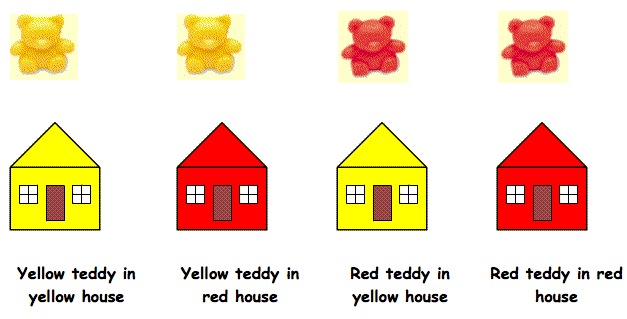
Ask them:
How can we make sure they are all
different?
Is there a way to go about making
the combinations so we don't leave any out?
Talk about being methodical and
systematic i.e. planning and checking
It is vital that the children understand how each of the above
is different from the rest and, in addition, that they realise you
can put a teddy in a house of the same colour (this has caused
confusion in past experience).
Discuss strategies for working out the arrangements of
combinations on the streets. Try inviting your pupils to
suggest:
Starting points -- what might we
put in the grid first and where?
Logical approaches to filling in
the grid
When a particular grid is complete, look for patterns and find
out whether these can be applied to the next grid size up. This can
also entail different recording/representation methods and allows
you to explore vocabulary of position.
Throughout all of this investigation, encourage the children
to explain their thinking orally. This may be to each other, or to
the class as a whole. Either way, it is vital in allowing them to
clarify their own ideas, reflect critically on their work and so
move themselves forward.