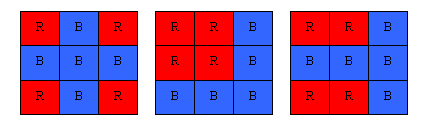
Correct solutions were received from Holly Unity Lee (Nottingham High School for Girls), Andrei Lazanu (School 205 Bucharest) and Michael Brooker (home educated).
I liked Holly's explanation. It is hard to write the solution to such a visual problem and it showed a lot of insight so I have included it here.
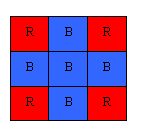
The answer to the first part is 1, because there are, logically, only three places that the first red counter could go:
If a red counter was put in the middle then two more would be
needed to go in corners (to give the diagonals an even number), and
two to go on the middle column and the middle row. This is five red
counters which are not available.
If a counter was placed in the middle of an edge then one would be
needed on a corner, and then another to go on a diagonal and
another to go along the side. The one along the side would then
need another in its column/row, again 5 red counters.
However, if one were placed in a corner then another would be
placed in that row and another in that column. the only way to do
it, to suit the diagonals, is to have a red counter in each
corner.
If the diagonals are not included, then two additional ways are possible. To create a solution the board must have symmetry, this meaning that the only other ways possible are having all four in one corner or having two on each side(opposite each other). If there was not symmetry then the counters would not work because each counter needs two more on its row and column, therefore they must also be able to form a square or a rectangle.