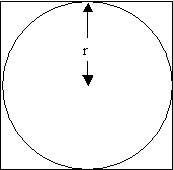
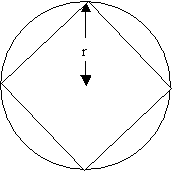
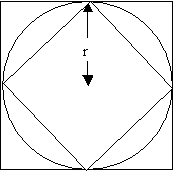
A method is to calculate the perimeters or areas of the inscribed and
circumscribed polygons to find an upper and lower limit for Pi. I have
included a solution from Andrei Lazanu below based on the perimeter of
the two polygons. You could then find the average of the two limits to
find an approximation to Pi. As Michael Brooker points out Pi is
irrational and therefore cannot be calculated exactly. We can still
obtain very good approximations to Pi using this method by increasing
the number of sides. No one really addressed the issue of the problems
with this method, especially for Archimedes as he did not have a calculator
or tables to look up roots of numbers. He had to find a method to calculate
square roots and I will be publishing a problem linked to this in July -
and very impressive the method is too!
Andrei's Solution
The length of the side of the circumscribed square is 2r, where r is
the radius of the circle. So, its perimeter is 8r.
Now, I calculate the length of the inscribed square, using the Pythagoras
Theorem, in a right-angled isosceles triangle, with the right angle in
the centre of the circle, the two congruent sides - radii of the circle,
and the a vertex of the hypotenuses - the side of the inscribed square:
2r2 = l2
l = rÖ2
So, the perimeter of the inscribed square is 4rÖ2.
Knowing that the circumference of a circle is 2pr, I can find a
minimum and a maximum limit for p from the condition that the
circumference of the circle is lower than the perimeter of the
circumscribed square and higher than the circumference of the
inscribed square:
4rÖ2 < 2pr < 8r
4Ö2 < 2p < 8
2Ö2 < p < 4
and approximating Ö2:
2.8284 < p < 4
The length of the side of the circumscribed square is 2r, where r
is the radius of the circle. So, its perimeter is 8r.
Now, I calculate the length of the inscribed square, using the Pythagoras
Theorem, in a right-angled isosceles triangle, with the right angle in
the centre of the circle, the two congruent sides - radii of the circle,
and the a vertex of the hypotenuses - the side of the inscribed square:
2r2 = l2
l = rÖ2
So, the perimeter of the inscribed square is 4rÖ2.
Knowing that the circumference of a circle is 2pr, I can find a
minimum and a maximum limit for p from the condition that the
circumference of the circle is lower than the perimeter of the
circumscribed square and higher than the circumference of the inscribed
square:
4rÖ2 < 2pr < 8r
4Ö2 < 2p < 8
2Ö2 < p < 4
and approximating Ö2:
2.8284 < p < 4
Now, I use the same method for the hexagon. First I calculate the side of
the circumscribed hexagon in a right-angled triangle with one side (the
hypotenuses) the line connecting the centre of the circle with the vertex
of the circumscribed hexagon, a side - half the side of the circumscribed
hexagon, and the other - the radius of the circle. The side of the hexagon
is perpendicular on the radius in the tangency point. The angle between the
radius and the hypotenuses is 30o (Here I use the Pythagoras Theorem
and also the theorem that says than in a right-angled triangle with one
angle of 30o, the side opposite to the angle of 30o is 2 times
smaller than the hypotenuses):
or
so,
The side of the inscribed hexagon is r. So, I found the following
inequalities:
6r < 2pr < 6* (2rÖ3)/3
6r < 2pr < 4Ö3r
6 < 2p < 4Ö3
3 < p < 2Ö3
and approximating Ö3:
3 < p < 3.4641