Correct and quite different solutions were received from Natasha Kholgade (Indian Language School, Lagos) and Julia Collins (Langley Park School for Girls, England). I have included both of them below. There is a more concise geometrical proof not involving trigonometry for anyone who wants to have another go at this problem but it still depends on the vital insight, noted by Natasha, that APQD is a cyclic quadrilateral.
Natasha's solution:
Given: ABCD is a Square, P is the mid-point of AB and DQ is perpendicular to PC.To Prove: AQ = AD
Construction: Construct line PR parallel to AD. Join BR.
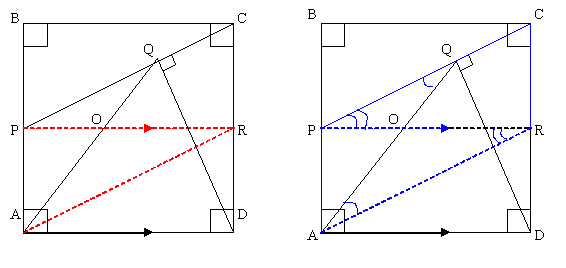
We consider quadrilateral APCR.
Since BP ll CR and BC ll PR (both ll AD), BPRC is a rectangle and BP = CR Thus AP = BP = CR. Also AP ll CR. Hence APCR is a parallelogram.
Hence PC ll AR. PR is a transversal. Since alternate interior angles are equal,
angleAQP = angleRAQ ?(i)
angleRPQ = angleARP ?(ii)
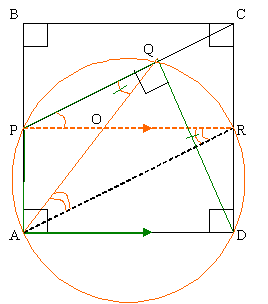
Now we consider quadrilateral ABCD.
Given angleCQD = 90 o and anglePQD = 90 o . Thus angleCQD + angle PQD = 180 o and PADQ is a cyclic quadrilateral.
Angles in same segment are equal.
Hence angleAQP = angleARP ?(iii)
From (i) and (iii), angleRAQ = angleARP ?(iv)
From (ii) and (iii), angleRPQ = angleAQP ?(v)
Sides opposite equal angles of a triangle are equal.
Hence in triangle POQ, OP = OQ [from (v)] ?(vi)
and in triangleAOR, OR = OA [from (iv)]. ?(vii)
Adding (vi) and (vii), we get
OP + OR = OQ + OA
Or PR = AQ
Since PR ll AD (by construction) and AP ll RD, APRD is a rectangle.
Therefore AD = PR = AQ
Hence AD = AQ.
Julia's Solution
Let angle BPC = a and the side of the square = a In triangle BPC, angle BCP = 90 - a In triangle QDC, angle DCQ = a(90 - angle BCP) In triangle PBC, BP = a/2, BC = (aÖ5)/2, cos = 1/Ö5 In triangle QCD, QC = a cosa = a/Ö5 PQ = PC - QC = (aÖ5)/2 - a/Ö5 = (3aÖ5)/10 In triangle AQD - using cosine rule:
|