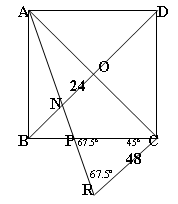
Well done all of you who sent in good solutions to this problem! Many different methods were used. Saul Foresta and Julia Collins found and used the exact value of tan 22.5 degrees which they found using trig formulae; Andre Lazanu used similar triangles; Kamen Marinov used the Sine Rule and Pythagoras Theorem; Hyeyoun Chung, Arun Ayer, Ngoc Tran and Yatir Halevi used the angle bisector theorem (BA:AO=BN:NO); Robert Goudie used an ingenious construction; and Dorothy Winn used several applications of the Sine Rule.
If you take triangle AON and double its size you form triangle ACR since AC is double AO.
So we now have two similar triangles AON and ACR and it is clearly the case that CR is double ON so CR = 48.
Since AR is the bisector of angle OAB we know that angle CAR = 22.5 o. Therefore angle CRA = 67.5 o.
Angle RCP must be 45 o since angle ACB is 45 o and angle ACR is 90 o. This implies that angle CPR is 67.5 o since 180 - 45 - 67.5 = 67.5.
Therefore triangle PCR is isosceles and so PC = CR and hence PC = 48 units.
I know that in a square the diagonals are also bisectors (in fact, this is true for the rhombus, and the square is a particular case of rhombus), so angle BAC and angle DAC have both the same measure: 45 o. The angles formed by the bisector of angle BAC with the sides of the angle have the following measure: 22 o30'.
I noted with L the side of the square, using the Pythagorean Theorem, AC = L√2
Now, I observe that AO is half AC: AO = (L√2)/2
Triangles AON and ABP are similar, because each one has a right angle, and there is another pair of equal angles (the ones formed by the bisector). So, I have:
So, I obtain the following proportion:
(L√2/2) / L = 24/BP
BP = 48 / √2 = 24√2 (units)
Now, I see that angle BPA has 67 o30' and angle BNP has the same measure, so triangle BNP is isosceles with BP = BN.
Here I observe that triangles ABN and ACP are similar, because their angles are respectively equal. So
As AB / AC = 1 / √2 it follows that PC = √2BN .
So
PC = √2BN = √2BP = 48