Well done all of you who sent in good solutions to this problem! Many different methods were used. Saul Foresta and Julia Collins found and used the exact value of $\tan 22.5$ degrees which they found using trig formulae; Andre Lazanu used similar triangles; Kamen Marinov used the Sine Rule and Pythagoras Theorem; Hyeyoun Chung, Arun Ayer, Ngoc Tran and Yatir Halevi used the angle bisector theorem ($BA$:$AO$=$BN$:$NO$); Robert Goudie used an ingenious construction; and Dorothy Winn used several applications of the Sine Rule.
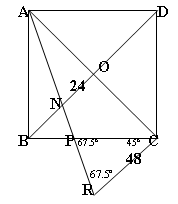
If you take triangle $AON$ and double its size you form triangle $ACR$ since $AC$ is double $AO$.
So we now have two similar triangles $AON$ and $ACR$ and it is clearly the case that $CR$ is double $ON$ so $CR = 48$.
Since $AR$ is the bisector of angle $OAB$ we know that angle $CAR = 22.5^{\circ}$ . Therefore angle $CRA = 67.5^{\circ}$.
Angle $RCP$ must be $45^{\circ}$since angle $ACB$ is $45^{\circ}$ and angle $ACR$ is $90^{\circ}$. This implies that angle $CPR$ is $67.5^{\circ}$ since $180 - 45 - 67.5 = 67.5$.
Therefore triangle $PCR$ is isosceles and so $PC = CR$ and hence $PC = 48$ units.
I know that in a square the diagonals are also bisectors (in fact, this is true for the rhombus, and the square is a particular case of rhombus), so angle $BAC$ and angle $DAC$ have both the same measure: $45^{\circ}$. The angles formed by the bisector of angle $BAC$ with the sides of the angle have the following measure: $22^{\circ}30`$.
I noted with $L$ the side of the square, using the Pythagorean Theorem, $AC = L\sqrt{2}$
Now, I observe that $AO$ is half $AC$: $AO = (L\sqrt{2})/2$
Triangles $AON$ and $ABP$ are similar, because each one has a right angle, and there is another pair of equal angles (the ones formed by the bisector). So, I have:
$$\frac{AO}{AB} = \frac{AN}{AP} = \frac{ON}{BP}$$
So, I obtain the following proportion:
$(L\sqrt{2}/2) / L = 24/BP$
$BP = 48 / \sqrt{2} = 24\sqrt{2}$ (units)
Now, I see that angle $BPA$ has $67^{\circ}30`$ and angle $BNP$ has the same measure, so triangle $BNP$ is isosceles with $BP = BN$.
Here I observe that triangles $ABN$ and $ACP$ are similar, because their angles are respectively equal. So
$$\frac{AB}{AC} = \frac{BN}{PC} = \frac{AN}{AP}$$
As $AB / AC = 1 / \sqrt{2}$ it follows that $PC = \sqrt{2}BN$.
So
$PC = \sqrt{2}BN = \sqrt{2}BP = 48$.