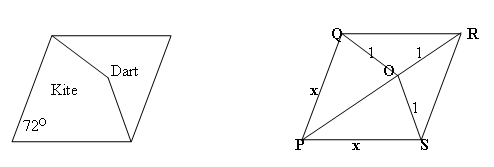
This solution is from Arun Iyer of SIA High School and Junior
College.
Part 1 First I will show that POR is a straight line. For
this I would like to state the perpendicular bisector theorem.
PERPENDICULAR BISECTOR THEOREM: Every point equidistant from the
two ends of a line segment lies on the perpendicular bisector of
the line segment.
Now consider the line segment QS.
OQ=OS=1 therefore by the perpendicular bisector theorem, O
must lie on the perpendicular bisector of QS.
PQ=PS (as the sides of the rhombus are equal), therefore by the
perpendicular bisector theorem, P must lie on the perpendicular
bisector of QS
RQ=RS (as the sides of the rhombus are equal), therefore by the
perpendicular bisector theorem, R must lie on the perpendicular
bisector of QS.
Now the perpendicular bisector of a line segment is unique and
hence P, O, R must lie on the same perpendicular bisector and
hence POR is a straight line.
Part 2 Now I will get all the angles of the rhombus.
ÐQPS = 72o (given), ÐQRS = ÐQPS = 72o
as they are opposite angles of a rhombus. The diagonal of the rhombus
bisects
the angles of a rhombus and therefore ÐQPO = ÐSPO = ÐQRO = ÐSRO = 36o.
Triangles OQR and OSR are isosceles triangles, therefore
ÐOSR = ÐOQR = 36o.
Using the fact that sum of angles of a triangle is 180 degrees, we
can see that ÐSOR and ÐQOR are equal to 108
degrees. Since we have proved that POR is a straight line in
Part 1, we can determine ÐQOP and ÐSOP to be 72
degrees.
Again using the fact that sum of angles of a triangle is 180
degrees, we can see that ÐOQP and ÐOSP are equal
to 72 degrees.
Part 3 Let the side of the rhombus be x.
Consider triangle
OPS in which PO=PS=x (since ÐPOS = ÐPSO).
Applying the cosine rule
|
cosOPS = [PS2 + PO2 - OS2]/[2× PS ×PO] |
|
therefore
|
cos36 = [2x2-1]/[2x2] (1). |
|
Splitting the isosceles triangle ORS into two right angled
triangles gives
From (1) and (2),
Now x ¹ 1 because triangle POS is not equilateral, therefore
x2 - x - 1 = 0 and hence
|
x = [1 + Ö5]/2 or x = [1 - Ö5]/2. |
|
Clearly x ¹ [1 - Ö5]/2 because the side
length cannot be negative, therefore x = [1 + Ö5]/2, the
Golden Ratio.