This solution is from Yatir Halevi.
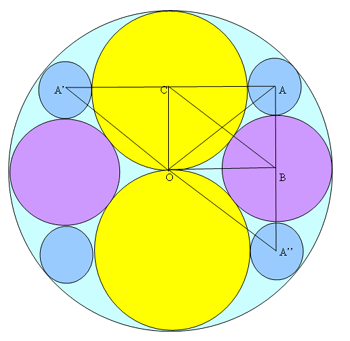
Let a, b and c be the radii the circles centered at A, B
and C respectively.
Angle BOC = 900 since, OB is tangent to the circle centered
at C and hence it is perpendicular to the radius. That also
means that the radius of the the circle centered at O is 2c.
As BC connects B and C it is equal to b+c.
By Pythagoras theorem: (2c−b)2 + c2 = (b+c)2. Hence
4c2=6bc and c can't be equal to 0 so 2c=3b.
We could extend the lines AC and BO, to create a mirror image,
where we have two circles centered at A ' and B ' with radii
a ' and b ' respectively, and due to symmetry issues, a ' =a and
b ' =b. We will also connect O with A ' and O with A.
Now OA=OA ' = 2c−a and AC = A ' C = c+a and so the line OC cuts
A ' A in half, and because the sides of the triangle A ' OA are
equal, OC is also perpendicular to A ' A, hence ∠OCA = 90.
As triangle ACO is a right-angled triangle, using Pythagoras'
Theorem: AC2+OC2=AO2 and so
which simplifies to 6ac=2c2 and c
can't be equal
to 0 so c=3a. Combining this with 2c=3b we get: 3b=6a that
is b=2a and so a=b/2=c/3, that is they are in the ratio 1:2:3
as required.
If we mirror the image in the line BO thus creating a new circle
below the one centered at B, centered at A ' ' it has the same
radius as A by symmetry. By the the same line of thought that we
used before, we reach the conclusion that ∠ABO=90. What we
get is that CABO has 3 right angles, meaning that the fourth is
also a right angle and that it is a rectangle and that triangle
ABC is also right angled.
Let's look at triangle OBC in which OB = 2c−b = 6a − 2a = 4a,
OC = c = 3a and BC = b + c = 2a+3a = 5a. So the ratio between
the sides are 3:4:5, like we wanted to prove.
Let's look at triangle ABC in which AB = a + b = a + 2a = 3a,
AC = a + c = a + 3a = 4a and CB = b + c = 2a + 3a = 5a. So the
ratio between the sides are 3:4:5, like we wanted to prove.
Arun Iyer proved this result by applying Descartes Circle Theorem.