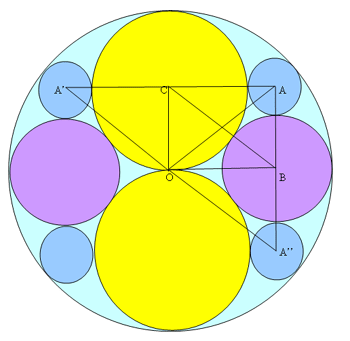
This solution is from Yatir Halevi.
Let
and
be the radii the circles centered at
and
respectively.
Angle
since,
is tangent to the circle centered
at
and hence it is perpendicular to the radius. That also
means that the radius of the the circle centered at
is
.
As
connects
and
it is equal to
.
By Pythagoras theorem:
. Hence
and
can't be equal to 0 so
.
We could extend the lines
and
, to create a mirror image,
where we have two circles centered at
and
with radii
and
respectively, and due to symmetry issues,
and
. We will also connect
with
and
with
.
Now
and
and so the line
cuts
in half, and because the sides of the triangle
are
equal,
is also perpendicular to
, hence
.
As triangle
is a right-angled triangle, using Pythagoras'
Theorem:
and so
which simplifies to
and
can't be equal
to 0 so
. Combining this with
we get:
that
is
and so
, that is they are in the ratio 1:2:3
as required.
If we mirror the image in the line
thus creating a new circle
below the one centered at
, centered at
it has the same
radius as
by symmetry. By the the same line of thought that we
used before, we reach the conclusion that
. What we
get is that
has 3 right angles, meaning that the fourth is
also a right angle and that it is a rectangle and that triangle
is also right angled.
Let's look at
in which
,
and
So the ratio between
the sides are 3:4:5, like we wanted to prove.
Let's look at
in which
,
and
. So the
ratio between the sides are 3:4:5, like we wanted to prove.
Arun Iyer proved this result by applying Descartes Circle Theorem.