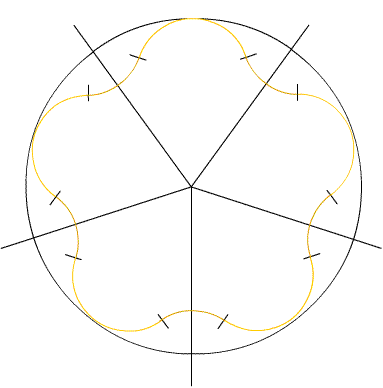
As I know that the figure stays inside a circle of radius 3r, is it easy to draw it.
Each node has at the end an arc of radius r, and of angle 144 degrees. The obtained figure is below.
See also:
This article on Arclets
I received two superb solutions from Sheila Norrie, Shona Leenhouts and Alison Colvin, and Sarah Gibbs, Kathryn Husband and Gordon Ducan from Madras College, St. Andrews. It is so difficult to do justice to them before our publication date for this month. I will try to work on them over the next couple of weeks and publish them, or at least a flavour of them next month. Well done to all of you. A solution based on the one received from Andrei Lazanu from School 205, Bucharest, Romania is used below - but do watch this space next month!
First, I looked at the figure with four nodes. The node is
formed from 2/4 of a circle, and the arc connecting two nodes of
1/4 of a circle.
The perimeter of this arclet is: $$4\pi \times (\frac{2}{4} +
\frac{1}{4}) = 4 \pi \times \frac{3}{4} = 3\pi$$
Looking at the figure with three nodes, I observe the same pattern: the node contains 2/3 of a circle, and the arc connecting two nodes 1/3. The perimeter of the figure is: $$3\pi \times (\frac{2}{3} + \frac{1}{3}) = 3\pi$$
The circumference of a circle of radius $r$ being $2\pi r$, the perimeter ($R$) is in this case $6\pi r$.
For n = 4, each node has at the end half a circle, and 4 quarters join them. So, there are in total 3 circles, with the same perimeter as before.
Now, I observed a pattern:
The node contains 2/n of a circle, and the arc connecting two nodes 1/n. The perimeter of the figure is: $$n\pi \times \frac{3}{n} = 3\pi$$
When n is very large the figure is very close to a circle. The
radius of this circle is 3r (three times the radius of the circle
whose arcs form the figure with "nodes",. from which the big
figure is formed).
This radius of the circle circumscribed to the figure is same for
any n. In fact, it is rather difficult to prove this, and I saw
it first for n = 4, where it could be observed directly that R is
formed by 3 small radii, and then for large n. May be it would be
necessary to use induction!.
Then I tested the formula I obtained for n= 5.
As I know that the figure stays inside a circle of radius 3r, is
it easy to draw it.
Each node has at the end an arc of radius r, and of angle 144
degrees. The obtained figure is below.
See also:
This
article on Arclets