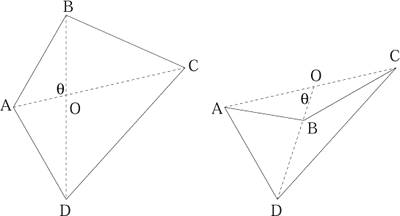
Tom Clarke and James Frederick Well from Queen Mary's Grammar School, Walsall and Shu Cao from Oxford High School gave this solution for a convex quadrilateral. Can you see how to adapt the solution for the case of the arrow shaped quadrilateral?
Suppose there is a convex quadrilateral
, the diagonals
and
cross each other at
. The angle between
and
is
degrees, the angle between
and
is the same. The angle between
and
is
degrees, the angle between
and
is the same.
The area of triangle
is
.
The area of triangle
is
.
The area of triangle
is
.
The area of triangle
is
.
The area of the quadrilateral is the sum of these four triangles.