Tom and James from Queen Mary's Grammar School, Walsall and Shu
Cao from Oxford High School gave this solution for a convex
quadrilateral. Can you see how to adapt the solution for the case
of the arrow shaped quadrilateral?
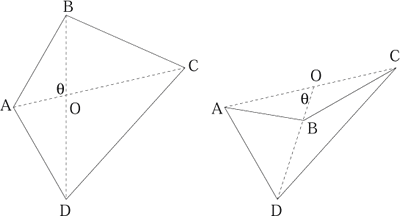
Suppose there is a convex quadrilateral $ABCD$, the diagonals
$AC$ and $BD$ cross each other at $O$. The angle between $AO$
and $BO$ is $\theta$ degrees, the angle between $DO$ and $CO$
is the same. The angle between $AO$ and $DO$ is $180-\theta$
degrees, the angle between $BO$ and $CO$ is the same.
The area of triangle $AOB$ is ${1\over 2}AO\times BO \sin
\theta$.
The area of triangle $AOD$ is ${1\over 2}AO\times DO \sin
(180-\theta)={1\over 2}AO\times DO \sin \theta$.
The area of triangle $DOC$ is ${1\over 2}DO\times CO \sin
\theta$.
The area of triangle $BOC$ is ${1\over 2}BO\times CO \sin
(180-\theta)={1\over 2}BO\times CO \sin \theta$.
The area of the quadrilateral is the sum of these four
triangles.
$$\eqalign{ {\rm Area}&={1\over 2}AO\times BO \sin
\theta+{1\over 2}AO\times DO \sin \theta+{1\over 2}DO\times CO
\sin \theta+{1\over 2}BO\times CO \sin \theta \cr &=
{1\over 2}[AO(BO+DO) + CO(DO+ BO)]\sin \theta \cr &={1\over
2}(AO\times BD+ CO\times BD)\sin \theta \cr &={1\over
2}AC\times BD \sin \theta }$$
So we have proved that for a convex quadrilateral the area of
the quadrilateral is given by half the product of the lengths
of the diagonals multiplied by the sine of the angle between
the diagonals.