This excellent solution came from Shu Cao of Oxford High School.
Well done Shu!
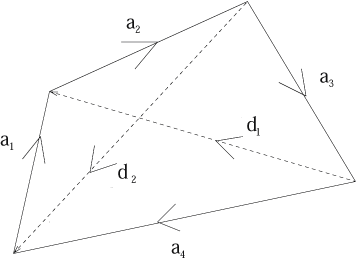
A convex quadrilateral $Q$ is made from four rigid rods with
flexible joints at the vertices so that the shape of $Q$ can be
changed while keeping the lengths of the sides constant.
Let ${\bf a}_1$, ${\bf a}_2$, ${\bf a}_3$ and ${\bf a}_4$ be
vectors representing the sides (in this order) so that ${\bf
a}_1+{\bf a}_2+{\bf a}_3+{\bf a}_4 = {\bf 0}$ (the zero
vector). Now let ${\bf d}_1$ and ${\bf d}_2$ be the vectors
representing the diagonals of $Q$. We may choose these so that
${\bf d}_1={\bf a}_4+{\bf a}_1$ and ${\bf d}_2={\bf a}_3+{\bf
a}_4$.
As ${\bf d}_1={\bf a}_4 + {\bf a}_1$ and ${\bf d}_2 = {\bf a}_3
+ {\bf a}_4$ it follows that ${\bf a}_1 + {\bf a}_2 = -{\bf
d}_2,\ {\bf a}_2 + {\bf a}_3 = -{\bf d}_1.$
$$\eqalign{ {\bf a}_2^2+{\bf a}_4^2-{\bf a}_1^2-{\bf a}_3^2
&=({\bf a}_2^2-{\bf a}_1^2)+({\bf a}_4^2-{\bf a}_3^2) \cr
&=({\bf a}_2-{\bf a}_1)({\bf a}_2+{\bf a}_1)+({\bf
a}_4-{\bf a}_3)({\bf a}_4+{\bf a}_3)\cr &=-{\bf d}_2({\bf
a}_2-{\bf a}_1)+{\bf d}_2({\bf a}_4-{\bf a}_3)\cr &={\bf
d}_2({\bf a}_4-{\bf a}_3-{\bf a}_2+{\bf a}_1)\cr &={\bf
d}_2(({\bf a}_4+{\bf a}_1)-({\bf a}_3+{\bf a}_2))\cr &={\bf
d}_2({\bf d}_1+{\bf d}_1)\cr &=2{\bf d}_2 {\bf .} {\bf d}_1
}.$$
Now ${\bf a}_1+{\bf a}_2+{\bf a}_3+{\bf a}_4=0$ implies that
${\bf a}_4=-{\bf a}_1-{\bf a}_2-{\bf a}_3$.
$$\eqalign{ {\bf a}_1 \cdot {\bf a}_3-{\bf a}_2 {\bf .} {\bf
a}_4 &= {\bf a}_1 {\bf .} {\bf a}_3-{\bf a}_2(-{\bf
a}_1-{\bf a}_2-{\bf a}_3) \cr &={\bf a}_1 {\bf .} {\bf
a}_3+{\bf a}_2 {\bf .} {\bf a}_1+{\bf a}_2{\bf .} {\bf
a}_2+{\bf a}_2{\bf .} {\bf a}_3 \cr &={\bf a}_1({\bf
a}_2+{\bf a}_3)+{\bf a}_2({\bf a}_2+{\bf a}_3) \cr &=({\bf
a}_1+{\bf a}_2)({\bf a}_3+{\bf a}_2) \cr &=(-{\bf
d}_1)(-{\bf d}_2) \cr &={\bf d}_1{\bf .} {\bf d}_2}.$$
Hence
$$\eqalign{ 2({\bf a}_1 {\bf .} {\bf a}_3-{\bf a}_2 {\bf .}
{\bf a}_4) &=2{\bf d}_1 {\bf .} {\bf d}_2 \cr &={\bf
a}_2^2+{\bf a}_4^2-{\bf a}_1^2-{\bf a}_3^2 .}$$
If the diagonals of $Q$ are perpendicular in one position of
$Q$, then $2{\bf d}_1 {\bf .} {\bf d}_2={\bf a}_2^2+{\bf
a}_4^2-{\bf a}_1^2-{\bf a}_3^2 =0$. As ${\bf a}_1,{\bf
a}_2,{\bf a}_3,{\bf a}_4$ are constant in length ${\bf
a}_2^2+{\bf a}_4^2-{\bf a}_1^2-{\bf a}_3^2$ will always be zero
which implies that ${\bf d}_1 {\bf .} {\bf d}_2=0$, so they are
perpendicular in all variations of $Q$.