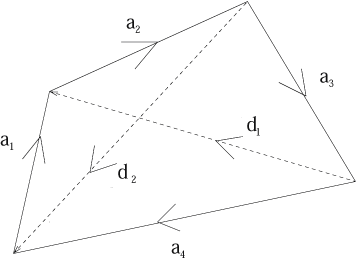
A convex quadrilateral Q is made from four
rigid rods with flexible joints at the vertices
so that the shape of Q can be changed while
keeping the lengths of the sides constant.
Let a1, a2, a3 and
a4 be vectors representing the sides (in
this order) so that a1+a2+ a3+a4 = 0 (the zero vector). Now
let d1 and d2 be the vectors
representing the diagonals of Q. We may choose
these so that d1=a4+a1 and
d2=a3+a4.
As d1=a4 + a1 and d2 = a3 + a4 it follows that
a1 + a2 = -d2, a2 + a3 = -d1.
a22+a42-a12-a32
=(a22-a12)+(a42- a32)
=(a2-a1)( a2+a1)+(a4-a3)( a4+a3)
=-d2(a2- a1)+d2(a4-a3)
= d2(a4-a3-a2+a1)
=d2((a4+a1)-(a3+ a2))
=d2(d1+d1)
=2d2.d1
.
Now a1+a2+a3+a4=0
implies that a4=-a1-a2- a3.
a1 ·a3-a2.a4
= a1.a3-a2(- a1-a2-a3)
=a1.a3+a2.a1+a2.a2+a2.a3
= a1(a2+a3)+a2( a2+a3)
=(a1+a2)( a3+a2)
=(-d1)(-d2)
=d1.d2
.
Hence
2(a1.a3-a2.a4)
=2d1.d2
= a22+a42-a12-a32 .
If the diagonals of Q are perpendicular in one
position of Q, then 2d1.d2=a22+a42-a12- a32 = 0. As a1,a2, a3,a4 are constant in length a22+a42-a12-a32 will
always be zero which implies that d1.d2=0, so they are perpendicular in all
variations of Q.