Sugam made a conjecture that the number
of ways a number can be written as a polite number is one less
than the number of odd factors and gave the following
example:
There are four odd factors of $15 (1,3,5,15)$
$15=7+8$
$15=4+5+6$
$15=1+2+3+4+5$
So the number of ways of expressing $15$ as sum of two or more
than two consecutive natural numbers is $4-1=3$
Yike looked at odd numbers, numbers of
the form $4m+2$, and numbers of the form $pm$ where $p$ is an odd
prime.
$n$ odd: $n$ can be written as $m + (m+1)$, where $m =
\frac{n-1}{2}$
$$ \eqalign {m + (m+1) &= \frac{n-1}{2} +
(\frac{n-1}{2}+1)\cr &= \frac{n-1+n-1+2}{2}\cr
&=\frac{2n}{2}\cr &=n \cr}$$
For example, $13 = 6 + 7$, $19 = 9 + 10$.
$n = 4m + 2$: $n$ can be written as $$(\frac{n-2}{4}-1) +
(\frac{n-2}{4}) +(\frac{n-2}{4}+1)+(\frac{n-2}{4}+2)$$
For example, $18 = 3 + 4 + 5 + 6$, $34 = 7 + 8 + 9 + 10$.
$n = pm$ where $p> 2$ and prime:
$$ n= \sum _{i=-\frac{p-1}{2}}^\frac{p-1}{2}m-i$$
Note that some terms in this sum may be
negative for certain values of $m$ and $p$, but they will be
cancelled out by the corresponding positive terms.
For example, $544 = 17 \times 32$
$$\eqalign{544 &= \sum_{i=-8}^{8} 32-i \cr &=
40+39+38+37+36+...+27+26+25+24}$$
$424=53 \times 8$
$$\eqalign{424 &= \sum_{i=-26}^{26}8-i \cr &=
34+33+32+...+2+1+0+-1+-2+...+-16+-17+-18 \cr &=
34+33+32+31+30+...+22+21+20+19}$$
Several people commented that all numbers
are polite except powers of 2. The following diagrams can be used
to show why powers of 2 are not polite.
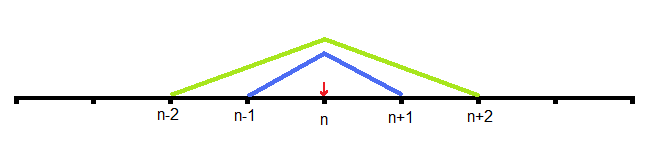
This diagram shows what happens when you add together an odd
number of consecutive numbers. The numbers either side of $n$ can
pair off, giving $2n$ each time, so we end up with an odd
multiple of $n$.
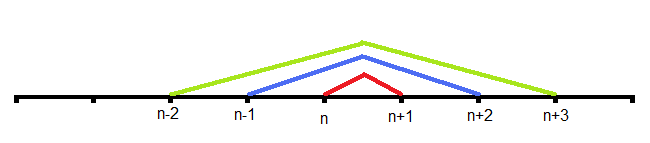
This diagram shows what happens when you add together an even
number of consecutive numbers. This time, the numbers pair off to
give $n+n+1=2n+1$ each time, so we end up with a multiple of an
odd number, $2n+1$
Thus all polite numbers must have at least one odd factor, so no
power of $2$ can be polite.