Some excellent ideas and approaches to this problem. The first part
of the problem (when the triangle is larger than the square) is
fairly accessible; as is the part where the two equal sides of the
triangle shrink to less than half the length of the side of the
square but the bit in between is tricky!!
The first solution offered below is based on the work of Thomas
Davies, Hannah McKenzie, Elliot Husband, Lizzie Farnham and Hannah
Bradley of Madras college The group also spent time looking at what
happens as the triangle shrinks (not so easy). Well done to all of
you.
The second solution is from Andrei Lazanu of School 205, Bucharest.
Thank you for this Andrei
Other excellent solutions were received from Alison Colvin, Sheila
Norrie and Shona Leenhouts, also of Madras College, who have partly
answered one of the January problems (if you tackle this problem
you can refer to what you did for tilting triangles). I think the
January version is a little easier.
Solution one
Introduction
We believed that the triangle took up a quarter of the square,
and that a total of four triangles could fit around the square. We
created a moving example:
Explanation
We started by rotating a square inside the four triangles as
this has the same effect as rotatiing the triangle (editors note:I
"liked this bit of lateral thinking").
From our "moving" representation (Fig. 1) we could see that it
is always possible to fit four right angled triangles around the
centre of the square. This is because the centre of the square
allows a 360° rotation and, as the traingles are right angled,
they have angles of 90° (360 / 90 = 4).
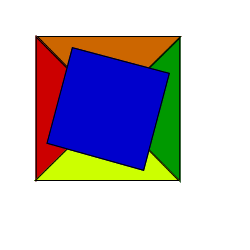
Fig 1
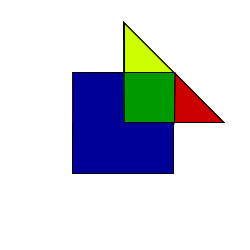
Fig 2
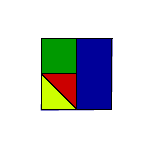
Fig 3
We believed that a quarter of the square was overlapped by
each triangle and we set out to prove this.
First we placed the triangle in a simple position on the
square (Fig. 2). We could clearly see that the green area of the
triangle is a quarter of the square - and what about the yellow and
red areas...?
We suspected that they added up to another quarter. To show
this we cut out the areas and stuck them on to the square (Fig. 3).
This showed that the yellow and green areas also took up a quarter
of the square and the the whole triangle took up half the
square.
We soon realised that this was only an example for one
position of the triangle - we needed to look at the bigger
picture.
The Bigger Picture
As can be seen the square in the
middle of the four triangles is 2 units by 2 units. This means that
the overlap of each of the four triangles is congruent and makes up
a quarter of the square.
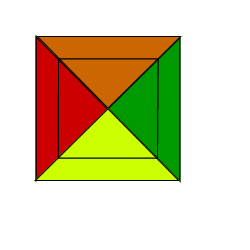
As the four triangles fit on the square at all times the
overlap of the triangles onto the square must always be a quarter
of the square which is equal to 1 square unit.
Conclusion
In our write up we have shown that 4 triangles can fit around
the square and that the area of overlap is 1 square unit. This is
always true as long as the sides of the triangle are 2 units.
The Second Solution
To find the length of the diagonal of a square of side 2, using the
Pythagorean Theorem:
22 + 22 = d2
So, d = 2Ö2.
1. Starting with the triangle with the two equal sides 2 units in
length.
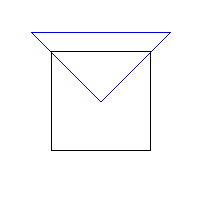
1a) If the hypotenuse of the isosceles triangle is parallel to one
side of the square.
This means the equal sides of the isosceles triangle are on the
diagonal of the square; the area of the square occupied by the
triangle is the area of the right-angled isosceles triangle, of side
half the diagonal.
This means that half the diagonal is Ö2 units. The area of
the triangle is
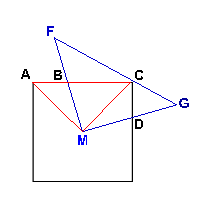
1b) The triangle is in a tilted position.
Triangles AMB and CMD are congruent, because they are formed by
the rotation of triangle FMG. This means their areas are equal.
So, the area of the square occupied by the triangle is the same. Any
position could be reduced to position a).
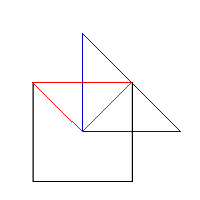
1c) The equal sides of the triangle are parallel to the sides of the
square.
It is very clear that the triangle forms in the square a smaller
square of area 1 unit2.
2. The congruent sides of the triangle are Ö2 units.
2a) The hypotenuse of the isosceles triangle is parallel to one side
of the square.
As seen from 1a, this is a particular case. The hypotenuse of this
triangle is the side of the square, also having the same area as in
1a.
2b) The triangle has a tilted position.
In this part of the problem, the area of the square covered by the
triangle is smaller than 1 unit2.
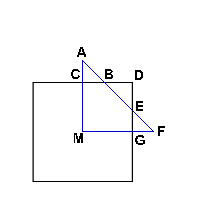
2c) The equal sides are parallel to the sides of the square.
Triangles ACB and AGF are both isosceles right-angled triangles,
with equal sides of Ö2 - 1 units because they are
right-angled triangles with 45° angle. So, BDE is also a
right-angled triangle with the congruent sides:
1 - (Ö2-1) = 2 - Ö2
The area of the polygon BCMGE is the area of quadrilateral DCMG
minus the area of triangle BDE. This is:
1 - [((2 - Ö2)2)/2] = 1 - [(4 + 2 - 4Ö2)/2] = 1 - (3 -2Ö2) = 2Ö2 - 2 units2
3. Here, I must find the limit where the area of the triangle is all
inside the square. This happens when triangle MAF is the same as
triangle MCG. This happens when the congruent sides of the
right-angled isosceles triangle are 1 unit. If I reduce further the
side of the triangle, all the triangle will be inside the square.
.