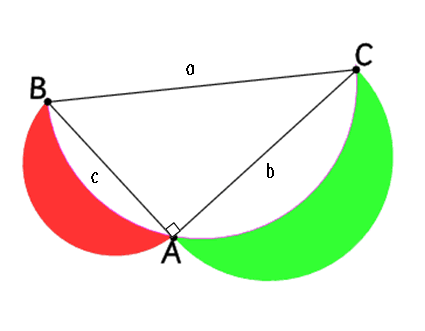
The trick with this question was not to make life difficult by
working values out. As a consequence some of you managed much
more elegant solutions than others. Here is an example based on
that offered by Shu Cao (very well done). Jeongmin Lee, Rebecca
Bartram (The Mount School, York) and Andrei Lazanu (School 205,
Bucharest) should also be congratulated.
Using Pythagoras` theorem in $ABC$,
$$\begin{eqnarray}a &=& \sqrt{b^2 + c^2} \\ \mbox{Area
of semicircle on BC} &=& \pi \frac {a^2}{4}\\
&=& S1\\ \mbox{Area of semicircle on AC} &=&
\pi \frac {b^2}{4}\\ &=& S2 \\ \mbox{Area of semicircle
on AB} &=& \pi \frac{c^2}{4}\\ &=& S3\\
\mbox{Area of crescents} &=& S2 + S3 + \mbox{Area ABC}
- S1\\ &=& \pi \frac {b^2}{4} +\pi \frac {c^2}{4} +
\mbox{Area ABC} - \pi \frac {a^2}{4}\\ &=& \pi \frac
{b^2}{4} + \pi \frac{c^2}{4} - \pi \frac {a^2}{4} + \mbox{Area
ABC}\\ &=& \frac{\pi}{4} \times ( b^2 + c^2 - a^2 ) +
\mbox{Area ABC}\\ &=& 0 + \mbox{Area ABC} \\
&=& \mbox{Area ABC} \end{eqnarray}$$