Many thanks to Andrei of School 205 Bucharest for the
inspiration for this solution. Well done Andrei. One might have
expected the triangular solution to be best. I wonder what happens
if you chop off the corners?
Using the following notation:
h - for the height of the cup and
d - for the diameter of the cup.
Test each of the two possible forms of the box, one with a
rectangular base and one with a triangle as its base:
Cuboidal box
As there are six cups they could be ordered in two ways:
1 x 6 cups
and
2 x 3 cups
For any cuboid box, the surface area is: 2 times the top area + 2
times the side area + 2 times the front area:
The total area of a 1 x 6 cups box is:
2 x (hx 6 xd + dx 6 xd + dxh) = 185470 mm2
The total area of a 2 x 3 cups box is:
2 x (hx 2 xd + hx 3 xd + 2 xdx 3 xh) = 157250 mm2 For a triangular prism box This case is illustrated in the figure of
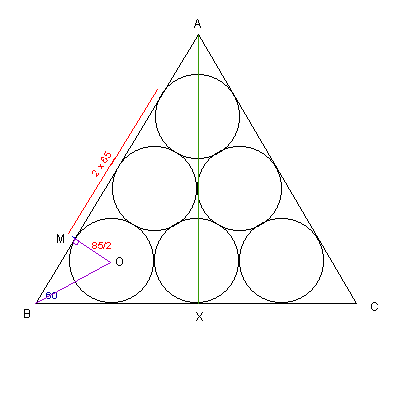
the problem.
The base is an equilateral triangle. The surface area is 2 times the
area of the equilateral triangle + 3 times the area of each of the
faces.
First calculate the side of the equilateral triangle ABC.
This is 2 x BM + 2 x 85 mm.
BM is a tangent to the circumference of a corner cup (centre O,
radius d/2 = 85/2 mm).
Also the angle MOB = 60°
Therefore angle MBO = 30°