Why do this
problem?
This problem provides a challenge when you are focusing on
drawing lines and shapes accurately or finding areas either by
counting squares or calculation. The problem calls on learners'
understanding of squares and right-angled triangles, and requires
working systematically and visualisation as well as reasonably
accurate drawing.
Possible approach
You could introduce this problem by making the beginnings of
the design using paper folding. Each learner will need a square of
paper. (This could be made in class by folding the end of the sheet
diagonally, thus forming a square and cutting off the
excess.)
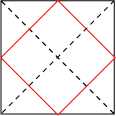
Take the square of paper and fold it both ways diagonally so
finding the centre. Fold each corner to the centre and crease it.
Thus forming the second square (in red).
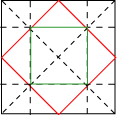
After this, fold each side to the centre and crease, forming
the third square (in green).
Learners could be challenged to continue this process which
becomes increasingly difficult and prone to inaccuracy. This
introduction will show learners where the problem "is coming
from".
Provide $1$ cm$^2$ paper, or even better, square dotty paper,
sharp pencils and rulers for working on the actual problem.
Learners would benefit from working in pairs so that they are able
to talk through their ideas with a partner but should do their own
drawing.
This sheet,
showing the diagram, could prove useful.
Learners could be left on their own to discover the best place
to start the drawing and the best size to choose, or the whole
group could discuss this together before they begin working
individually.
At the end of the lesson learners can discuss both their
methods for tackling the drawing and for finding the area of the
four triangles. There are several different ways of answering the
problem and it can be done without any drawing at all, so there
should be plenty to talk about. It might be useful, if no one has
suggested it, to cut out the four triangles and put them together
as a square.
Key questions
What would be a good way to start, with the first, smallest
square or the largest one?
How big should you draw the centre square to make it easier to
draw the others?
Is that a $45^o$ angle?
Now you have done the drawing, how are you going to find the
area of the four triangles?
Possible extension
Learners who find this problem straightforward could find the area
of each of the successive squares in the diagram and predict the
size of the next squares, or try the problem
Fitted, and/or
Baravelle.
Possible support
Children could start with a $4 \times 4$ square and then draw a
second square at $45^o$ to this with each side centred
on a corner of the first square. Each side of this
second square will be placed diagonally across two squares. A third
and successive squares can be drawn in the same way.