| Congratulations Aleksander from
Gdynia Bilingual High School No3, Poland for your excellent
solution to the Cocked Hat problem. As you will see, the
solution hinges on simplification of an algebraic
expression and solving a quadratic equation. |
Here is Aleksander's solution.
First we will rearrange the expression from implicit to explicit
form. The given equation is
|
(x2 + 2ay -a2)2 = y2(a2 - x2) |
|
Squaring the LHS gives
|
4a2y2 + 4ay(x2-a2) + (x2 - a2)2 = y2(a2 - x2). |
|
Collecting like terms gives the quadratic equation
|
y2(3a2+x2)+ 4ay(x2-a2) + (x2 - a2)2 = 0. |
|
The discriminant is
|
D = 16a2(x2 - a2)2-4(3a2+x2)(x2-a2)2 = (x2 - a2)2(4a2-x2) = 4(a2 - x2)3. |
|
Solving this equation we get:
|
|
|
= |
|
-4a(x2 - a2)± |
| _________
Ö4(a2 - x2)3
|
2(3a2+x2)
|
|
| |
| = |
|
(x2-a2)(-2a± |
| ______
Ö(a2-x2)
|
) |
(3a2+x2)
|
|
|
|
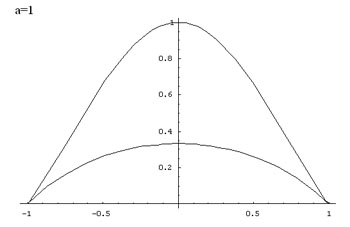
For each value of a there are two branches of the graph given by
taking the +ve and -ve signs in this equation. Values of y are only
defined for the interval -a £ x £ a. The domain of f(x) is
-a £ x £ a. The zeros of the function are given by x = a
and x = -a.
Additionally, the function is symmetric with respect to the y-axis,
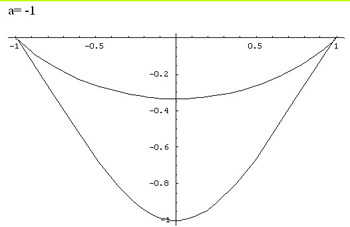
because x always appears in even powers. Graphs for parameters a = n and a = -n and are symmetric to each other with respect to the
x-axis, that is y(n) = y(-n). Proof:
|
|
|
(x2-n2)(-2n± |
| ______
Ö(n2-x2)
|
) |
(3n2+x2)
|
= - |
|
(x2-(-n)2)(-2(-n)± |
| ________
Ö(-(n)2-x2)
|
) |
(3(-n)2+x2)
|
|
|
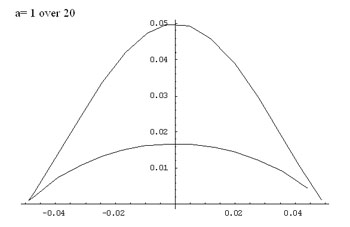
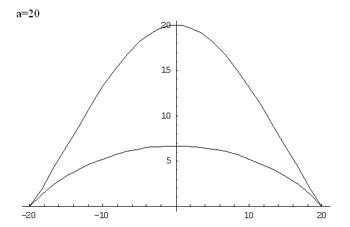
Here are some graphs of the function: