Many thanks to those of you who sent in solutions to thie problem including Mai Yifan of The Chinese High School Singapore and Andrei Lazanu of School 205 Bucharest. Thanks also to the pupis of Madras College who answered the first part of this problem as part of their solution to tilting triangles (November 2002).
P is the centre of the square ABCD
If the sidesPQ and PS of the square PQRS conincide with PB and PC then the overlapped area is PBC.
By symmetry (or congruence) PBC has an area which is one quarter of the area of ABCD.
Rotating the square PQRS about P gives a diagram equivalent to the one opposite.
We know that PBC is a quarter of ABCD so if we can show that the area of PXCY = area of PBC then the overlap will always be a quarter of the square.
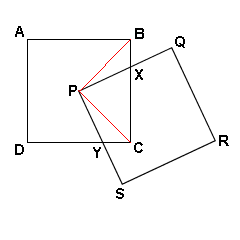
To prove this we need to show that triangle PBX is congruent to triangle PYC.
PB = PC ( half the diagonal of the square)
angle PBX = angle PCY (diagonals of square bisect the
angles).
angle CPY = angle BPX =angle of rotation
Therefore triangles BPX and CPY are congruent (ASA)
Area PXCY = Area XPC + Area CPY = Area XPC + Area BPX = Area BPC
Therefore PXCY is a quarter of the square.
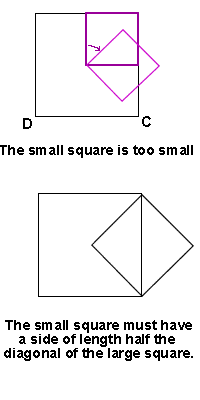
Let the length of the side of the large square is x and the the length of the diagonal is d.
Using Pythagoras Theorem
From this we know that the limit of the length of the side of the small square is: