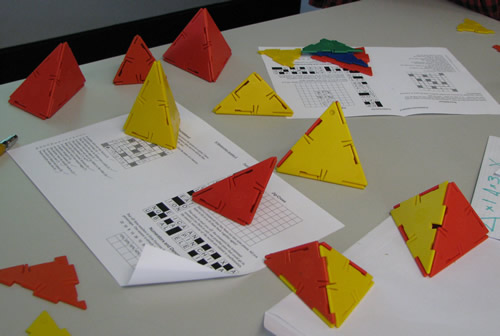
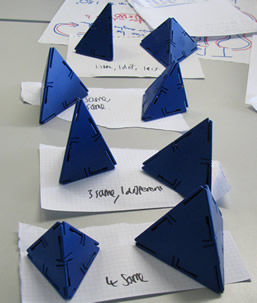
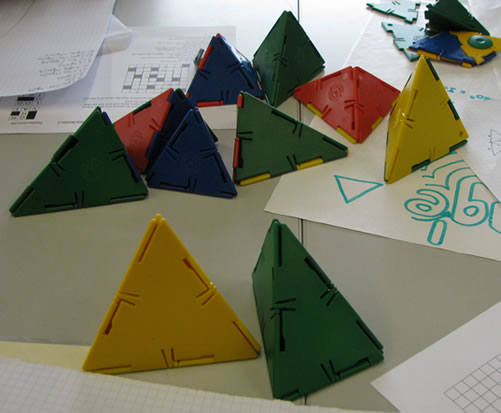
Students attending a masterclass at the
Thomas Deacon Academy in Peterborough tried to work on this
problem systematically. Here are examples of how they went about
it.
I think their ideas are excellent and give
an insight into how you might make a convincing argument that you
have all possibilities. Well done to you all for trying to
describe your approaches to this problem.
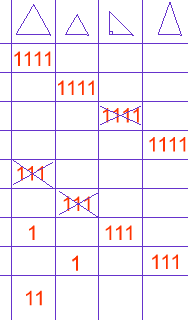
Susannah, Adam, Maria and Erin adopted an
approach like the one illustrated in this table. Can you see how
they have been systematic and continue their argument? Thanks for
this neat idea .
Stephen, Hugh, Daniel and Deepak, adopted
a similar approach. Firstly, they identified and coded each of
the four triangles, identifying the long and the short sides of
each. Then they considered sets of four triangles in a systematic
way. Can you see how they worked systematically from the table
below:
| All the same |
E,E,E,E |
SE,SE,SE,SE |
I,I,I,I |
R,R,R,R - no |
| 3 and 1 |
E,E,E,SE- no |
E,E,E,I - no |
E,E,E,R-no |
|
|
SE,SE,SE,E - no |
SE,SE,SE,I -no |
SE,SE,SE,R-no |
|
|
I,I,I,E - no |
I,I,I,SE |
I,I,I,R - no |
|
|
R,R,R,E |
R,R,R,SE - no |
R,R,R,I - no |
|
| 2 and 2 |
... |
... |
... |
|
Emily, Clara, Lizzie and Kieran chose an
approach using some further ideas to help them be more
efficient:
- There are only two lengths of sides (long, as in the length
of the sides of the large equilateral triangle and the
hypotenuse of the right-angled triangle; short, as in the
length of the sides of the small equilateral triangle and the
short side, or base, of the isosceles triangle).
- There must be an even number of long and and even number of
short sides in the sets of four triangles that form the
tetrahedron if the triangles fit together.
- The even number of sides have to be spread across the
triangles, for example four shorts are no good if three of them
are all on a small equilateral triangle.
We coded the triangles as follows:
Big equilaterals - EB
Small equilaterals - ES
Isosceles - I
Right-angled - R
We tabulated all possibilities and quickly crossed out those
without an even number of long and an even number of short
sides. We then considered whether we could actually make those
left, like this (I have not included
the whole of their table but can you see how they were
systematically listing all the possibilities ):
|
|
|
|
Even number of longs and shorts/does it work? |
| I |
I |
I |
I |
YES/YES |
| EB |
EB |
EB |
EB |
YES/YES |
| ES |
ES |
ES |
ES |
YES/YES |
| R |
R |
R |
R |
YES/NO |
| EB |
EB |
EB |
I |
NO |
| EB |
EB |
EB |
ES |
NO |
| EB |
EB |
EB |
R |
NO |
| I |
I |
I |
ES |
YES/YES |
| I |
I |
I |
R |
NO |
| I |
I |
I |
EB |
NO |
| R |
R |
R |
I |
NO |
| R |
R |
R |
ES |
NO |
| R |
R |
R |
EB |
YES/YES |
| ES |
ES |
ES |
I |
YES/NO |
| ES |
ES |
ES |
EB |
NO |
| ES |
ES |
ES |
R |
NO |
| EB |
EB |
I |
I |
YES/YES |
| EB |
EB |
I |
ES |
YES/NO |
and so on...
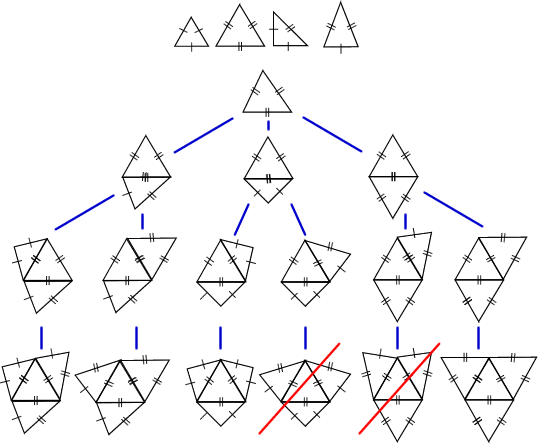
Chris, Rana, Nabil and Indrajeet took a
quite different approach, using tree diagrams. Here is one of
the diagrams they produced. They needed to do a tree diagram
starting with each of the triangles and look carefully for
duplications .
Other solutions we have received included
one from Mark Johnson, who found tetrahedra that use these
triangles:
1 small equilateral 3 isosceles
1 big equilateral 3 right-angled
2 big equilateral 2 isosceles
4 small equilateral
4 big equilateral
2 small equilateral 2 right-angled
2 isosceles 1 right-angled 1 big equilateral
2 isosceles 2 right-angled (two different
arrangements produce tetrahedra that are reflections of each
other )
Yanqing from Lipson Community College can
add one more to Mark's list :
1 small equilateral 1 isosceles 2 right-angled
Altogether we have found a total of 10
different tetrahedra.