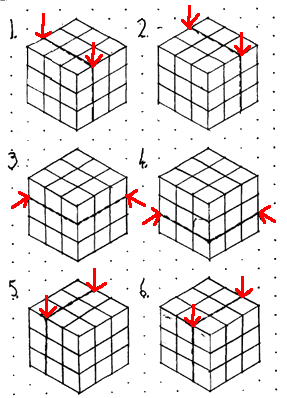
Jake, Ryo and Charlie from Moorfield Junior School have explained how to cut up a 3x3x3 cube using 6 cuts:
"We got a 3 by 3 cube and then we cut it 2 times to make 3 lots of 9 cubes. Then we piled all the cubes on top of each other. Then we took another 2 cuts to leave 9 towers of 3 cubes. Next we layed them next to each other. After that we took another 2 cuts to leave the 27 unit cubes."
Chris B, Elliot and Joseph, also from Moorfield Juniors, sent us a diagram to show where these cuts should be:
Juliette noticed that it wouldn't be
possible with fewer than 6 cuts:
"We need at least 6 cuts because we need one cut for each face of
the small cube in the middle of the $3\times 3 \times 3$
cube."
Anthony noticed that, with a $4 \times 4
\times 4$ cube, we can use 6 cuts if we rearrange the
cubes:
"First cut the cube in half down the middle, then stack the
halves on top of each other (in an $8 \times 2 \times 4$
arrangement) and cut down the middle, to make four $4 \times 4$
slices each 1 unit thick. Then rearrange the cubes into the
original arrangement and repeat the process in the other two
directions. This will cut the cube into $1 \times 1 \times 1$
cubes. It cannot be done with fewer than 6 cuts because the cubes
in the middle will each need at least one cut for each
face"
The $n \timesn \timesn$ cube is a bit
trickier. Try a few yourself before looking at this
explanation.
First of all let's see how many cuts are
needed to cut the cube into slices 1 unit deep. We can then do
this in each of the three directions to cut the $n \timesn
\timesn$ cube into unit cubes, and can multiply by three to find
out how many cuts are needed in total.
For a cube with side length 3 or 4 units,
we need 2 cuts, as Juliette and Anthony explained. For 5 units,
we'll need an extra cut in each direction. To cut as efficiently
as possible, we should use a method similar to Anthony's: first
cut in half (or as close to in half as possible), then stack up
the "halves" and repeat until we are left with "slices" 1 unit
thick. We can then put the cube back together and repeat for the
other two directions.
The general pattern is: for each doubling
of $n$, we need an extra 3 cuts to cut an $n \timesn \timesn$
cube into $1 \times 1 \times 1$ cubes. This is shown in the table
below.
| n | Number of cuts |
| 1 to 2 | 1 x 3 |
| 3 to 4 | 2 x 3 |
| 5 to 8 | 3 x 3 |
| 9 to 16 | 4 x 3 |
| (2k-1 + 1) to 2k | k x 3 |