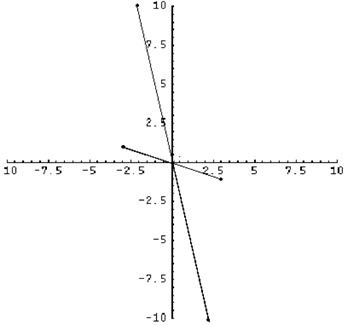
Our conjecture is that multiplying a point on the
Argand diagram by -1 is equivalent to a 180
degree rotation about the origin.
Let
on the Argand diagram represent the
complex number
, where
is the square
root of -1. So, multiplying
by -1, we get
, which is represented by the point
in the Argand diagram. However, the
point
is a rotation of the point
by 180 degrees about the origin. QED.
Using the same numbers for the second part, our
conjecture here is that multiplying a complex
number by
gives a rotation of 90 degrees
anti-clockwise on the Argand diagram.
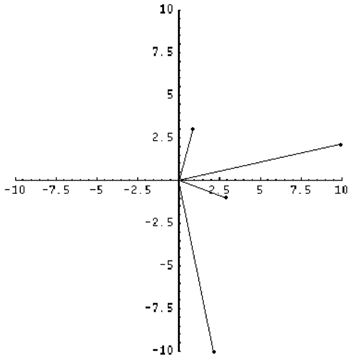
Again, assuming
is a complex number
plotted on the Argand diagram, by multiplying
by
, we get the complex number
,
which is represented by the point
on the
Argand diagram. This is equivalent to a rotation
of 90 degrees anti-clockwise about the origin.
QED.
Assuming we were to multiply the number by
twice, this would give a rotation of 180 degrees
(as shown in the first part because
).
Multiplying by
thrice would be equivalent to
a rotation of 270 degrees anti-clockwise, or 90
degrees clockwise and four time maps the number
onto itself (essentially multiplying by 1).
Multiplying by
times is equivalent to
rotating the point 90 degrees anti-clockwise
times. Therefore; if
is 0 mod 4, it has no
effect; if
is 1 mod 4, it's equivalent to an
anti-clockwise rotation of 90 degrees; if
is
2 mod 4, it's equivalent to a rotation of 180
degrees; if
is 3 mod 4, it's equivalent to a
rotation of 90 degrees clockwise.
NB. All these rotations are rotations of the
initial point (a,b) about the origin as the
centre of rotation.