Use the diagram to prove the double angle formula, where $t=\tan
\theta$: $$\tan2\theta = {2t\over {1-t^2}},\quad \sin2\theta =
{2t\over {1+t^2}},\quad \cos2\theta = {{1-t^2}\over {1+t^2}}$$
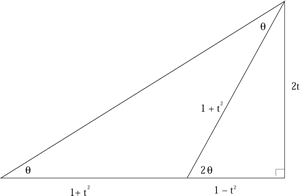
The point $P'=(p',q')$ is the image of the point $P=(p,q)$ after
reflection in the line $y=mx$. To find $(p',q')$ use the fact that
the midpoint of $PP'$ is on the line $y=mx$ and the line segment
$PP'$ is perpendicular to the line $y=mx$ and show that
$$p'=p\cos2\theta + q\sin2\theta,\ q'=p\sin2\theta -
q\cos2\theta\quad (1)$$ where $m=\tan\theta$. Hence establish
another proof that the matrix
$$T_2= \left( \begin{array}{cc} \cos 2\theta &\sin2\theta \\
\sin2\theta &-\cos2\theta \end{array} \right) $$
gives a reflection in the line $y=x\tan\theta$. The point
$P''=(p'',q'')$ is the image of the point $P'$ after reflection in
the line $y=x\tan\phi$. Apply the transformation $$T_2' = \left(
\eqalign{\cos 2\phi &\sin2\phi \\ \sin2\phi &
-\cos2\phi}\right)$$ to the point $P'=(p',q')$ to find the
coordinates of the point $P''$ in terms of $p, q, \theta$ and
$\phi$. Hence show that the combination of two reflections in
distinct intersecting lines is a rotation about the point of
intersection by twice the angle between the two mirror lines. What
is the effect of the two reflections if the lines coincide (i.e.
$\theta=\phi$)?