In both parts of this question we consider the limiting case of a
process which is repeated infinitely often and things are not
what they might seem to be."
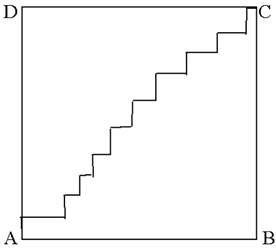
(a) In a square $ABCD$ with sides of length 1 unit a path is
drawn from $A$ to the opposite corner $C$ so that the steps in
the path are all parallel to $AB$ or parallel to $BC$ and not
necessarily equal steps. Draw paths of this sort with 5 steps, 10
steps, 20 steps ... Find the total length of the path in each
case. What would the length of such a path be if it had 1000
steps? What about the length of the path with 1 million steps? Is
there anything surprising about this result? Suppose you keep
increasing the number of steps in paths from $A$ to $C$ of this
sort, putting in more and more and more steps. What can you say
about the total length of the path?
(b) Now draw the graphs of $y={1\over 2^n}\sin 2^nx$ for $n=
1,2,3, ...$ and $0\leq x \leq 2\pi$. As $n$ tends to infinity the
graphs oscillate more and more and get closer and closer to the
$x$ axis. Prove that the length of the curve from $x=0$ to $x=2
\pi$ is the same for all values of $n$.