Andaleeb sent in this excellent solution.
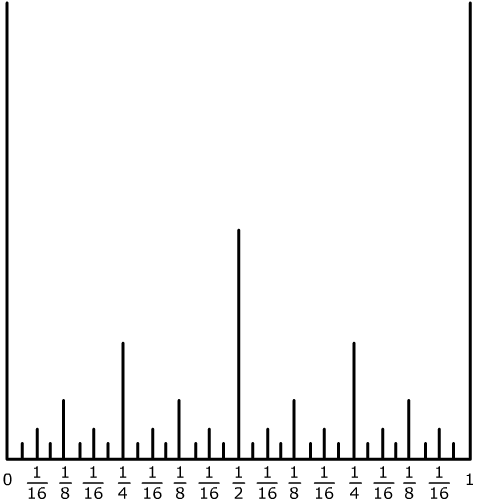
The diagram shows some of the vertical lines drawn for values of
x between 0 and 1 as described in the question. The lines are of
height 1 unit at x = 0 and 1, of height ${1\over 2}$ units at $x=
{1\over 2}$ , of height ${1\over 4}$ units at $x= {k\over 4}$ and
${1\over 8}$ units at $x= {k\over 8}$ and so on... up to ${1\over
2^5}$ at ${k\over 2^5}$ where $k$ is a positive integer.
| n |
$0$ |
$1$ |
$2$ |
$3$ |
$4$ |
$5$ |
$6$ |
$\dots$ |
$n$ |
$n+1$ |
| Height |
$1$ |
${1\over 2}$ |
${1\over 4 }$ |
${1\over 8}$ |
${1\over 16}$ |
${1\over 32 }$ |
${1\over 64}$ |
$\dots$ |
${1\over 2^n}$ |
${1\over 2^{n+1`}}$ |
| Lines cut |
$2$ |
$1$ |
$2$ |
$4$ |
$8$ |
$16$ |
$32$ |
$\dots$
|
$2^{n-1}$ |
$ 2^n$ |
Thus if the height $h$ lies in ${1\over 2^n} > h> {1\over
2^{n+1}}$ then the number of lines cut is given by $$ 2 + 1 + 2 +
4 + 8 + ... + 2^{n-1} = 2 + {{2^n - 1} \over {2 - 1}} = 2^n +
1.$$ As $n$ tends to infinity the height of the lines tends to 0
and the number of lines cut tends to infinity.