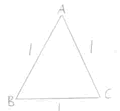
Perimeter = 3 x 1 = 3
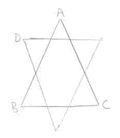
Perimeter = 3 x 4 /3 = 4
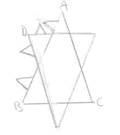
Perimeter = 3 x 16 /9 = 48 /9 = 16 /3 = 5 1 /3
Caroline and Bronya from Tattingstone School sent wonderfully explained solutions to this problem. Caroline drew some diagrams to help her:
|
|
Side AB = 1 Perimeter = 3 x 1 = 3 |
|
|
Side ADB = 4 x 1 /3 = 4
/3 Perimeter = 3 x 4 /3 = 4 |
|
|
Side ADB = 4 x 4 /9 = 16
/9 Perimeter = 3 x 16 /9 = 48 /9 = 16 /3 = 5 1 /3 |
She explains:
The pattern is every time you add on a new smaller spike you multiply by 4 and divide by 3.
Here, Bronya describes how she approached the problem:
First of all I looked at the perimeter of the equilateral triangle. It was 3 units. Then I looked at the perimeter of the star. If one side is 11 /3 units then the perimeter is 4 units. Then the perimeter of the third shape. I looked at a section like this:
Each section = 1 /3 + 1 /9 unit = 3 /9 + 1 /9 = 4 /9 unit
There are 12 sections so the total perimeter = 4 /9 x 12 /1 = 48 /9
I looked at all the perimeters as ninths:
Perimeter 1 was 27 /9
Perimeter 2 was 36 /9
Perimeter 3 was 48 /9
Each time the perimeter increases by one third.
I think this comes about because in each section a third of the section is added on.The perimeter of the next shape would be 64 /9 because:
48 divided by 3 is 16 therefore increase 48 /9 by 16 /9
Total would be: 48 /9 + 16 /9 = 64 /9
Thank you to you both - these are very well reasoned solutions. I wonder whether you could generalise to any shape in this series?