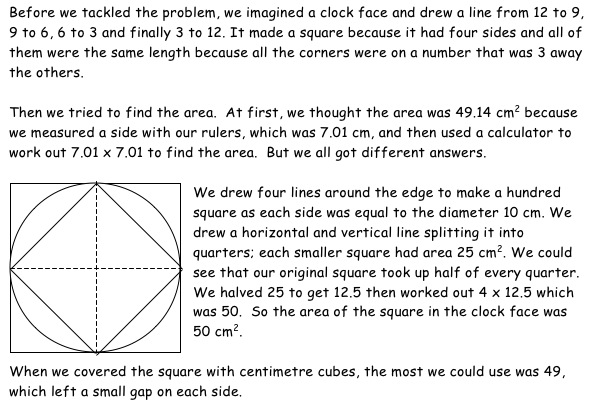
We had a large number of interesting
ideas sent in for this activity, too many to show here, but it
revealed that many pupils are still working to understand the
names and properties of shapes as well as the methods for
calculating area.
Isaac from Ecole Internationale de
Ferney-Voltaire sent in this thorough explanation of what is
involved.
The answer to the first part of the problem is that the shape
that he has made is a square. This is so because there is an
equal distance from the points $12$ to $3$, $3$ to $6$, $6$ to
$9$, and $9$ to $12$. A polygon of four equal sides creating
four right angles is by definition a square.
In this problem we are given the diameter of the circle that
the square was made from, and asked to give the area. In this
problem the diameter is given by connecting the points of $12$
and $6$. Doing this also divides the square in half giving two
right isosceles triangles. We also know that the diameter is
$10$ cm. Using the Pythagorean theorem we can find the two legs
of a triangle that is half the square. The Pythagorean theorem
states that $A^2 + B^2 = C^2$. In this case we can adjust it to
$A^2 + A^2 = C^2$, since all sides are equal. We know that the
hypotenuse is $10$ cm long so $A^2 + A^2 = 10^2 (or 100)$. If
we divide $100$ by $2$ we then get $50$, so $A^2 (or 50) + A^2
(or 50) = C^2 (or 100)$. To find what A is we must find
$\sqrt50 (or A^2)$. $\sqrt50$ is $7.071067812$ then just find
$7.071067812$ x $7.071067812$ which is really unnecessary since
we had to find the square root of $50$ to get
$7.071067812$.
In conclusion the area of the square located inside the clock
is $50$ cm squared.
The answer to the third question is really quite simple. We
know that we can only line up seven $1$cm by $1$cm tiles on one
side of the square since the sides length is $7.071067812$ and
we are not allowed to go outside the line. This is the same for
all the sides since the shape is a square. So $7$ tiles x $7$
tiles is $49$ tiles.
From Anna, Elsa, Huw and Molly from the
Extension Maths Group, St Nicolas C of E Junior School, Newbury
we had the following good account sent in as a document.
From Sarah at the Pioneer Valley
Performing Arts Charter Public School, Massachusetts U.S.A. we
had another well thought out account of the problem.
The problem is that Harry drew a picture of a clock. The
clock had a diameter of $10$ cm. He drew a straight line from
the $12$ to the $3$, from the $3$ to the $6$, from the $6$ to
the $9$, and then from the $9$ back to the $12$. I needed to
figure out what shape was drawn, and the number of whole
centimeter tiles that could fit into Harry's shape.
The first thing I did was draw the clock and the shape. The
shape looked like a square, but I had to make sure. I know
that on a clock, the numbers are an equal distance apart.
Therefore, the shape has all equal sides. But a square needs
to have four right angles. There are $360^\circ$ in a circle.
Divided into two parts, there is $30^\circ$ per Hr on a
clock. There are three numbers in between each of the corners
on the shape. $30$ x $3$ = $90$, so each corner has a
$90^\circ$, or right angle and the shape is a square.
Next I needed to find the area of the square. I divided the
square in half to make two triangles. Then I needed to find
the area of one of the triangles. I could see that the base
of the triangle was the same as the diameter of the circle,
$10$ cm. I could also see that the height of the triangle was
half the diameter, $5$ cm. The area of a triangle is half of
the base times the height, $10$ x $5$ (base x height) equals
$50$. One half of $50 = 25$. The area of one of the triangles
is $25$. The two triangles are equal, so they both have an
area of $25$. $25$ x $2$ = $50$.
If the clock was drawn with a different diameter, this
problem could be done the same way. The larger the diameter,
the larger the area of the shape. It could also be done in
reverse. One could be given the area of the shape and then
find out the diameter.