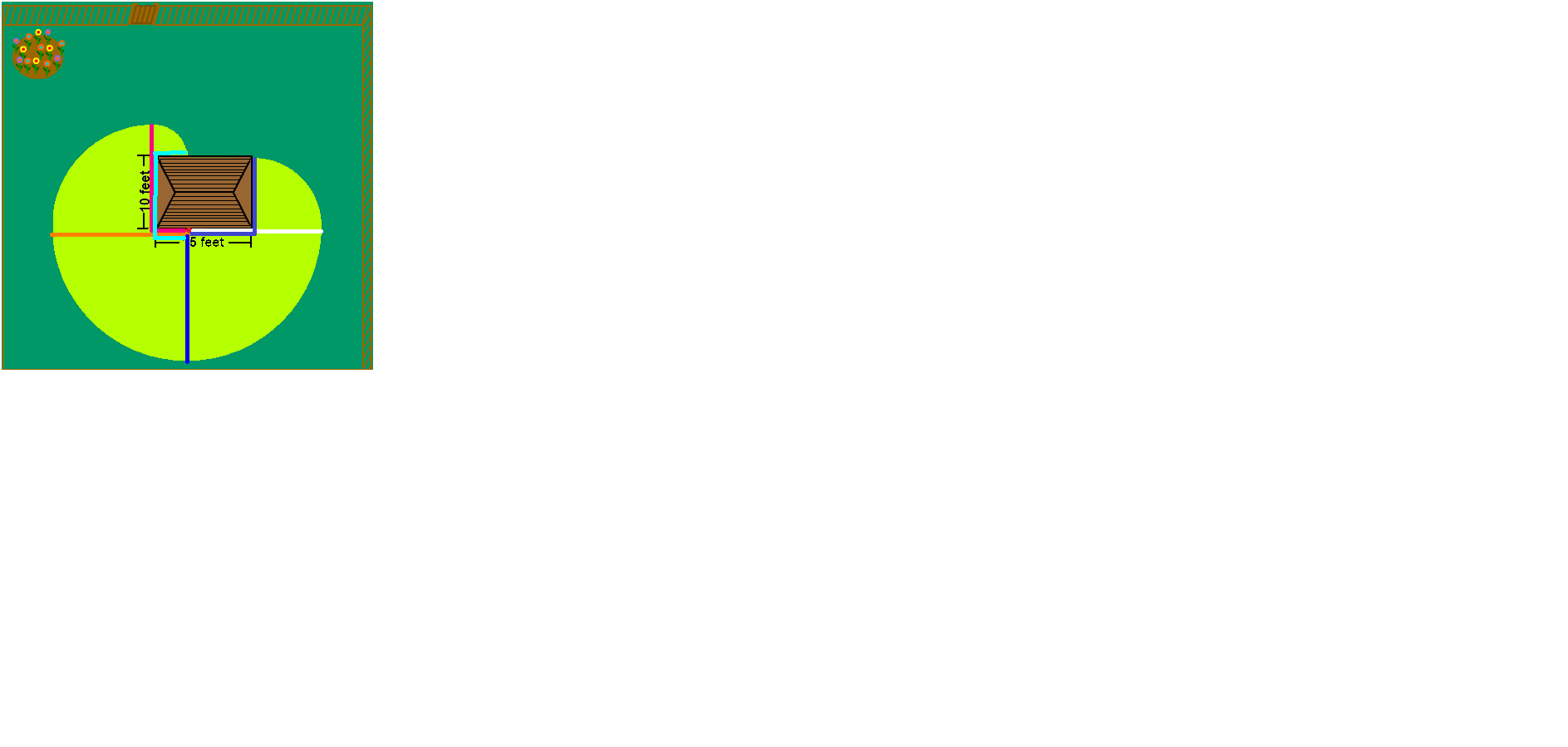
There were lots of solutions submitted
and most of you got the right answer, that the goat was tied up
on a long side of the shed, 5 feet from the bottom left corner
of the diagram in the question. There were a couple of
different ways of working this out:
Stuart has fixed the rope 5 feet from the bottom left hand
corner - This is because there is 20 feet to the top right
corner which is where the goat got to and how long the rope
is.
(thanks, Thomas from Wilson's
School)
Stuart fixed the rope directly above the lowest point of the
lower semi-circle as it was the only place that would let the
goat eat all of the grass that it did on the diagram.
(Hussein, also from Wilson's
School)
The goat is tethered 5 metres in on the side where the
majority of grass has been eaten. Therefore the goat can eat
the full half on its walls side (South side). The rope can
then bend round east for the 10 metres along the wall then
north and another 10 metres along the side. On the west side
the rope goes 5 metres west then 10 metres along the west
wall and then the remaining 5 metres of the rope is used
eating as far as it can along the north wall. The goat then
eats the grass that it can reach in those regions.
(a nice explanation from James, also
from Wilson's School)
Danielle from Darrington C of E
Primary School used a picture
to help explain her
answer.
Well done to Tim, Michael, Muntej,
Jamie, Charlie and Kartik, who all got this
right.
Kartik and Tim went on to work out the
area of grass eaten by the goat. Both of them did this by
splitting the area up into several shapes, all of which were
halves or quarters of circles, and adding the areas
together.
I think the area available to the goat was 904 foot squared.
This is because if you look at the shape, you can split it
into 3 quarter circles and one semi-circle. You then work out
the area of the different parts and add them all up.
A few of you considered the problem of
whether the goat would have a larger area to graze if the
location of where it was tied changed.
Kartik provided a beautifully
worked set of examples to show that it did vary and went on to
suggest that the grazing area is greatest when the goat is
tethered at a corner.
Elliott and Oliver also showed that
tethering the goat to a corner increased its grazing
area.
If you put the goat on the bottom right corner of the shed then
the area =
$(20\times 20 \times \pi) \times 0.75 =
300 \pi$
$+ {{10 \times 10 \times \pi }\over {4}} =
{25 \pi}$
$+ {{5 \times 5 \times \pi }\over {4}} =
{6.25 \pi}$
$300 + 25 + 6.25 = 331.25 \pi$
$= 1040.65 ft^2$
Oliver from Colchester Royal Grammar
School considered a different approach to this.
The area eaten is 287.5$\pi$
$ft^2$. If there was no shed in the way the total possible area
for the goat to eat is:
$A= \pi \times 20 \times 20=400\pi$
So the shed is stopping the
goat eat an area of 112.5$\pi$ feet squared of grass. This
uneatable bit could be reduced by tying the goat at the corner
of the shed because the goat is further away from the
centre of the shed. The area of available grass is
now:
$A= (3 \times {{\pi x 20 x 20}\over{4}}) + ({{\pi x 10 x
10}\over{4}}) +({{\pi x 5 x 5}\over{4}})$
$A= 300\pi + 25\pi + 6.25\pi$
$A = 331.25\pi$
which is roughly 1040.65 feet squared.
Alastair, Ed and Llewellyn from St
Peter's College also came to the same conclusion.
Aswaath's (Garden International School,
Malaysia)
solutions include a formula to
show that you get the greatest grazing area when the
goat is tethered at the corner.
But can we be sure that tethering the
goat to the corner provides it with the maximum possible
grazing area for any length of rope?
Maybe you could try to prove
this.