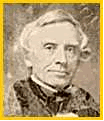
 Morse code was
invented by an American called Samuel Finley Breese Morse,
(1791-1872). He was not only an inventor but also a famous
painter.
Morse code was
invented by an American called Samuel Finley Breese Morse,
(1791-1872). He was not only an inventor but also a famous
painter.
Before the invention of the telegraph, most messages that had
to be sent over long distances were carried by messengers who
memorized them or carried them in writing. These messages could
be delivered no faster than the fastest horse.
In 1830, Joseph Henry (1797-1878) made the first long-distance
telegraphic device. After becoming interested in electricity in
1827, Samuel invented a telegraph system which was the first
device for sending messages using electricity. Telegraph
messages were sent by tapping out a special code for each
letter in the form of long and short signals. Short signals are
referred to as dits (represented as dots). Long signals are
referred to as dahs (represented as dashes). The code was
converted into electrical impulses and sent over telegraph
wires. A telegraph receiver on the other end of the wire
converted the impulses back into to dots and dashes, and
decoded the message.
In 1844, Morse demonstrated the telegraph to the United States
Congress using a now famous message "What hath God
wrought"..
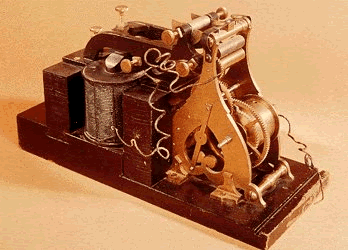
Samuel Morse Telegraph Receiver
Smithsonian National Museum of American History
Morse's original code was not quite the same as
the one in use today as it included pauses as well as dahs and
dits. However, a conference in Berlin in 1851 established an
international version, which is shown below:
| A |
. - |
N |
- . |
| B |
- . . . |
O |
- - - |
| C |
- . - . |
P |
. - - . |
| D |
- . . |
Q |
- - . - |
| E |
. |
R |
. - . |
| F |
. . - . |
S |
. . . |
| G |
- - . |
T |
- |
| H |
. . . . |
U |
. . - |
| I |
. . |
V |
. . . - |
| J |
. - - - |
W |
. - - |
| K |
- . - |
X |
- . . - |
| L |
. - . . |
Y |
- . - - |
| M |
- - |
Z |
- - . . |
The most well-known signal sent using Morse Code is:
. . . - - - . . .
and is the distress signal SOS.
Morse code requires the time between dits and dahs, between
letters, and between words to be as accurate as possible.
A Dit takes - 1 unit of time
A Dah takes - 3 units of time
The pause between letters - 3 units of time
The pause between words - 7 units of time
The speed at which a message is sent in Morse code is
normally given in words per minute (WPM). The word "Paris" is
used as the length of a standard word. How long does this take?
(Answer is given at the end of the article). An experienced
Morse code operator can send and receive messages at a rate of
20-30 WPM.
One of Morse's aims was to keep the code as short as
possible, which meant the commonest letters should have the
shortest codes. Morse came up with a marvellous idea. He went
to his local newspaper. In those days printers made their
papers by putting together individual letters (type) into a
block, then covering the block with ink and pressing paper on
the top. The printers kept the letters (type) in cases with
each letter kept in a separate compartment. Of course, they had
many more of some letters than others because they knew they
needed more when they created a page of print. Morse simply
counted the number of pieces of type for each letter. He found
that there were more e's than any other letter and so he gave
'e' the shortest code, 'dit'. This explains why there appears
to be no obvious relationship between alphabetical order and
the symbols used.
Answer:
Paris = 34 time units.
You can download
a morse code font for windows here.