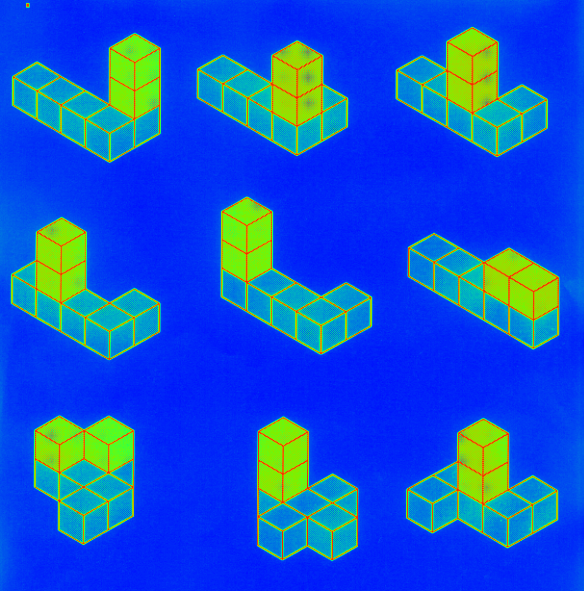
This is an investigation which uses the very popular multilink cubes. As well as these you need an awful lot of paper for the pupils recording. I think, that as with many investigations, pupils should have the opportunities of recording in any way that they prefer. So, square dotted paper, triangular dotted paper, square paper both 2 cm and 1 cm, triangle marked paper as well as plain paper. It would be good if the children, as in most classes, have access to rulers, crayons, fibre tips, coloured sticky paper etc. etc.
I like to often introduce an investigation with a few words that might capture their imagination that sets the scene, so here goes:-
"Imagine that we are called on to design some modern buildings. The town in which they are to be built want all of them to be different in the way that they look. There are to be 7 rooms in these modern homes, all of them will be the same size, with five on the downstairs level and just two on the upstairs level. We have these cubes to use to help us make the designs. We really want to try to get as many different designs as possible. And, if that does not really appeal to you, then lets imagine that we are here to create some models of interesting creatures from another planet that have to have 5 parts of their body touching the ground and the other 2 parts must not touch the ground." [or anything else that you know as their teacher appeals to them in which the underlying rule is that 5cubes must touch the ground and 2 cubes must not.
I think it is good to carry on this introduction by getting 5 cubes of one colour and 2 of another colour , put five together in a "flat" shape resting on a surface that they can all see. Ask the pupils if that obeys the first rule about the five, then turn the shape around and ask if that obeys the rule. When you are satisfied that they have got that, you could ask some pupils to come and place the two "upstairs" cubes on it and check that everyone is quite happy with the two rules. This may seem to be rather unnecessary to many people, but I do find that there are often cases when pupils are in the middle of some investigation that a teacher has set up and the pupils are not quite clear as to the rules.
So, with the rules in place and the pupils eager to get started the pupils are released from the group discussion and go off to have a go at the challenge. I have used this activity with pupils aged from 6 to 12 years. There are a number of interesting approaches that I have witnessed [ these are not in any particular order of sophistication or implication.]
Some pupils:
There are some variations that many children come across. Some times they ask "are these allowed?" A good reply may be "Well, what are the rules that we are using.?..........do these keep the rules?"
Some pupils start in one way and then change the way that they are working. There is also quite often some good discussions on symmetry and whether it should be allowed or not. I usually allow each child to make up their own mind as to whether these two are the same or not:
When deciding that they are making houses they point out sometimes that walking past the front of these two houses you see two different houses that are reflections ( like a pair of semi detached houses) but others who are working with the idea of just making shapes have some interesting ideas. I think that very often for the latter children there can be time given to reflect and the children may develop some of their spacial concepts much further than they were at the start of the challenge.
Some pupils :-
Make all the possibilities with a base shape, including the overhangs and then see whether there are the same number of arrangements for each different base, when exploring the small "x" base they are surprised how few there are.
Have a really successful, confident time and then come across the '2' and the 'S' shape and cannot decide whether they are the same or not.
I have asked children who are working in a system and seem confident to image the models in their head and try to tell me how many of that style there are ( perhaps on a particular base). When the time comes to an end I have always found they have thoroughly enjoyed themselves and are eager to talk about their thoughts and many of them can say a lot about their own ways of working. I sometimes talk about extensions(?) when you might have 3 on top instead and ask what difference it would make . . .
If open, investigative challenges are something that you are a little wary of then this is certainly a good starter that should allow you to get the "feel" of working investigatively.