Sue Liu of Madras College, St Andrew's also sent a very good
solution to this problem. Well done Sue!
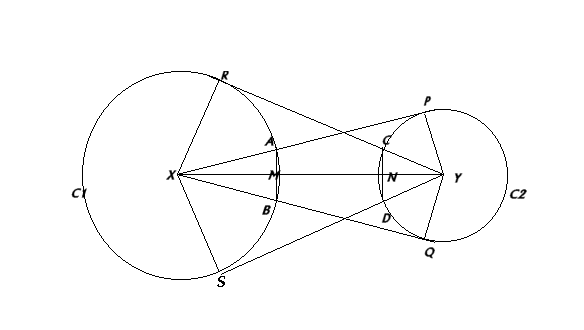
Conjecture: $AB = CD$
Proof We start with
Sue's proof that $XY$ is the axis of symmetry of the whole
shape.
$XP = XQ$ because they are two tangents from one external
point.
$\angle XPY = \angle XQY = 90^{\circ}$.
$YP = YQ = r$ so $PYQX$ is a kite and $XY$ is the axis of
symmetry of $PYQX$.
Similarly
$YR = YS$ because they are two tangents from one external
point.
$\angle YRX = \angle YSX = 90^{\circ}$.
$XR = XS = R$ so $RXSY$ is a kite and $XY$ is the axis of
symmetry of $RXSY$.
Therefore $XY$ is the axis of symmetry of the whole shape.
Sue then goes on to prove in detail that $ABDC$ is a rectangle.
Her proof is an excellent piece of work though a little longer
than the proof below. The following proof uses sines but it
could equally well be written entirely in terms of similar
triangles.
The radii of the two circles $C1$ and $C2$ are given by:
$XR = XA = R$
$ YP = YC = r$.
Let $M$ and $N$ be the midpoints of the chords $AB$ and $CD$.
Note that $M$ and $N$ are on the line $XY$ joining the centres
of the circles and the angles $AMX$ and $CNY$ are right angles.
As $XP$ is a tangent to the circle with centre $Y$, angle $XPY$
is a right angle.
From the right angled triangles $AXM$ and $YXP$
$$\sin\left(\angle AXM\right) = \frac{AM}{R} = \frac{r}{XY}
\qquad \qquad (1)$$
Similarly $YR$ is a tangent to the circle with centre $X$ and
angle $YRX$ is a right angle.
From the right angled triangles $CYN$ and $XYR$
$$\sin\left(\angle CYN\right) = \frac{CN}{r} = \frac{R}{XY}
\qquad \qquad (2)$$ From equations (1) and (2) we have $$AM =
CN = \frac{rR}{XY}$$ Hence $AB = CD$.