napolean
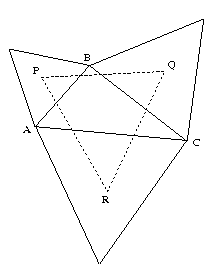
Triangle ABC has equilateral triangles drawn on its edges. Points P, Q and R are the centres of the equilateral triangles. Experimentation with the interactive diagram leads to the conjecture that PQR is an equilateral triangle.

There are many ways to prove this result. Here we have chosen one which uses only the cosine rule and one which uses complex numbers to represent vectors, and multiplication by complex numbers to rotate the vectors by 60 degrees.

Another proof using a tessellation of the plane is discussed on the 'Cut-the-knot' website.

First the proof using the Cosine Rule. The sides of triangle ABC are written as a, b and c. Centroids of equilateral triangles are at the intersection of the altitudes so ÐPAB and ÐRAC are both 30 degrees. Hence
AP = 2
3
. Ö3 c
2
= c
Ö3
and
AR = 2
3
. Ö3 b
2
= b
Ö3
.
It follows that ÐPAR = (ÐA + 60) degrees. By the cosine rule
PR2 = AP2 + AR2 - 2AP.AR cos(ÐA+60) = 1
3
(c2 + b2 - 2bc cos(ÐA + 60)     (1).
Now
cos(ÐA + 60) = 1/2cosA - Ö3
2
sinA

and, from \triangle ABC:
cosA = b2 + c2 - a2
2bc

and
sinA = 2Area\triangle ABC
bc

. Substituting for cos(ÐA + 60) in (1) and simplifying the expression gives:
PR2 = 1
3
é
ê
ë
a2 + b2 + c2
2
+ 2Ö3 Area\triangle ABC ù
ú
û
.
This formula is completely symmetric in a, b and c and it follows that RQ2 and QP2 have the same value and that \triangle PQR is equilateral.

Next the proof using complex numbers as vectors. We use l = epi/3 so that l2 = l- 1.

Also multiplying a complex number by l rotates it by 60 degrees.

Referring to the given diagram let A, B, C be represented by the complex numbers a, b, c. The third vertex of the equilateral triangle drawn on AB is represented by the complex number a+ l(b-a). Therefore the centre of this triangle P is represented by p where
p = 1
3
([2 - l]a +[1 +l]b).
Similarly
q = 1
3
(2 - l]b +[1 + l]c),
and
r = 1
3
(2 - l]c +[1 + l]a).
To show that PQR is equilateral it is sufficient to show that r - q = l[p - q] and this follows using simple algebra and l2 = l- 1.