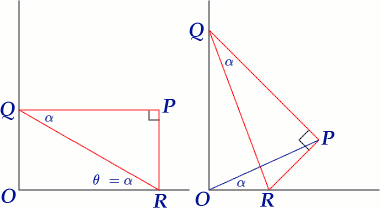
The locus of the point P is a straight line as the vertices Q and R slide along the walls.


diagram Sue Liu of Madras College, St Andrew's sent this solution to the problem. "Without loss of generality we can let the length of QR be 1 unit, and take a coordinate system with the origin at O and axes along OR and OQ.

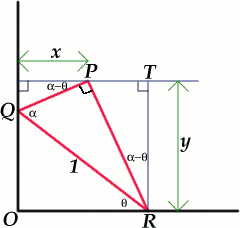
If ÐPQR = a, where 0 < a < 90°, then PQ = cosa and PR = sina. Let ÐQRO = q where 0 £ q £ 90°. Then, from the right angled triangles PSQ and PTR, we have ÐPRT = ÐQPS = a- q, and hence we can write down the coordinates of the point P.


x
=
cosacos(a- q)
y
=
sinacos(a- q).
We see that
y
x
= sinacos(a- q)
cosacos (a- q)
= tana.
and so P lies on the straight line y = xtana.

The position (x,y) depends only on cos(a- q), a being a constant, and q a variable. The distance of the point P from O is given by
OP2 = x2 + y2 = cos2(a- q)(cos2a+ sin2a) = cos2(a- q).
Hence OP = cos(a- q) which is a maximum when cos(a- q) = 1, that is when a = q. This occurs when OQPR is a rectangle as shown in the diagram. "


We get an even simpler method of solution by using the fact that the angles QOR and QPR are both 90 degrees so that OQPR is a cyclic quadrilateral with PR as a chord. We have ÐPOR = ÐPQR = a because these two angles are subtended by the same chord of the circle. This shows that ÐPOR is constant and hence that the locus of P is the straight line y = x tana.

What can you say about the locus of P if the triangle PQR is not a right angled triangle?