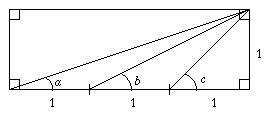
This method uses aspects of other proofs presented (and therefore could be shortened) but we include it because it gives a nice example of how complex numbers, matrices and all other methods fit nicely together.
Let $r=\sqrt{x^2+y^2}$.
Now, the complex number corresponding to the point with coordinates $(x, y)$ in the argand diagram can be written as
$$
z= x+iy = r\exp\left(i\tan^{-1} \left(\frac{y}{x}\right)\right)
$$
Let $z'$ be the complex number obtained by rotating $z$ by $2(a+b)$ degrees. Then we can use the identities $\sin(a+b) = \sin a \cos b +\cos a\sin b$ and $\cos(a+b) = \cos a \cos b-\sin a \sin b$ to see that:
$$
\begin{eqnarray}
z' &=& r\exp\left(i\tan^{-1}\left(\frac{y}{x}\right)+2i(a+b)\right)\cr
&=& r\left[\cos\left(\tan^{-1}\left(\frac{y}{x}\right)+2(a+b)\right)+i\sin\left(\tan^{-1}\left(\frac{y}{x}\right)+2(a+b)\right)\right]\cr
&=&r\left[\cos\left(\tan^{-1}\left(\frac{y}{x}\right)\right)\cos\left(2(a+b)\right)-\sin\left(\tan^{-1}\left(\frac{y}{x}\right)\right)\sin\left(2(a+b)\right)\right]\cr
&& +ir\left[ \sin\left(\tan^{-1}\left(\frac{y}{x}\right)\right)\cos\left(2(a+b)\right)+\cos\left(\tan^{-1}\left(\frac{y}{x}\right)\right)\sin\left(2(a+b)\right) \right]
\end{eqnarray}
$$
We can simplify the arctangents by considering the following diagram:
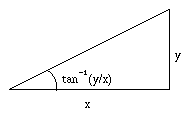
From this we can see that $\cos\left(\tan^{-1}\left(\frac{y}{x}\right) \right)= \frac{x}{r}$ and $\sin\left(\tan^{-1}\left(\frac{y}{x}\right) \right)= \frac{y}{r}$
This simplifies the expression for $z'$ to
$$
z' = x\cos\left(2(a+b)\right)-y\sin\left(2(a+b)\right)+i\left(y\cos\left(2(a+b)\right)+x\sin\left(2(a+b)\right)\right)
$$
Alex and Neil then used some double angle formulae and the fact that $\sin(a+b)=\cos(a+b)=\frac{1}{\sqrt{2}}$ to determine that
$$
z' = -y+ix
$$
Since this is a complex number rotated through $90^\circ$ we can conclude that $a+b = 45^\circ$