Thank you for all the answers you sent to this problem, however only a few of you described what you did to work out an answer. Sarah from Welton Primary School had a good way of putting the ladybirds in the box:
In the first column you put one in the top box and one in the second box.Thank you for taking us through your thinking, step by step, Sarah. Here is a picture of the way Sarah put the ladybirds into the box:
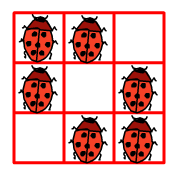
Stephen found this same arrangement of ladybirds, but went about it in a slightly different way. He said:
I worked out that column 1 could have two ladybirds, so row 3 could have two ladybirds, one each at the bottom of column 2 and column 3.Yara, who goes to the British International School of Riyadh wrote:
I did it by trial and error.That's a good way to have a go at this probelm, Yara. (Although I like to call it 'trial and improvement'!) This means that you start by putting the ladybirds in any way, and then swap them around so that it works.
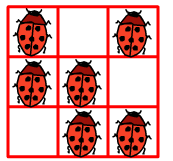
Several children from the Bishop Harvey Goldwin School sent in well-explained methods too. Here is the first one:
I firstly put three bugs diagonally so that there was one bug in each row and column.Here is a picture of this solution (which is definitely different from Sarah's, isn't it?):
Joel from Carr Green and Holly from Blockley both found four solutions to this problem. (I like the way you looked for more than one answer.) Here are the four that Joel sent which use 'L' to stand for a ladybird. Holly sent the same four solutions, but used a circle for a ladybird which is just as good. It's important to find a way to write things down that helps you.
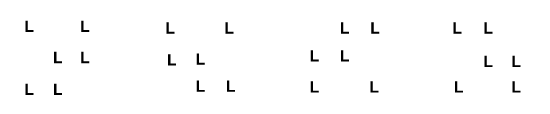
Do you notice anything about these solutions? How do they compare to the one from Bishop Harvey Goldwin School?
I would suggest that they are all in fact the same as each other - just turned (rotated) or reflected. However, you may have counted them as different, which is fine. If we do say they are different, might there be other ways to draw Sarah's solution?