Fence It


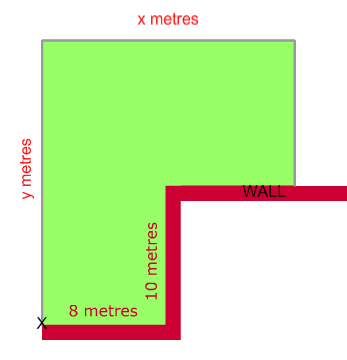
The solutions below all refer to this diagram:


Many solutions got very close to the optimum solution :

Pauline and Amy from Moorfield Junior School, Mollie from St.Michael's C.of.E Primary School, and Akalya and Vanessa from Devonshire Primary School all arrived at the same conclusion.

This is what Akalya and Vanessa wrote:

For this problem you have to do a trial and error method.

My answers were: $x = 14$m $y = 18$m, and the third side is $8$m.

The maximum area was $192$m².

Fred and Matt from Albion Heights Junior Middle School noticed that there were two solutions that gave an area of 192m²:

I (Matt) began to use paper, but soon realised it could be solved mentally.
We realised that on the left side, ten metres of fencing would be required for every possible shape.
So we would have to make a shape with $30$m.
Using a trial and error method, we came upon two maximums:
$8\times 14$ (where $x =14$) and $7\times16$ (where $x=16$).
Both rectangles have an area of $112$m².
To add up the amount of fencing, add two times the width to the length. ($16+14=30$, $14+16=30$)
To get the maximum area, we add the $10\times8$ rectangle to the $8\times14$ (or to the $7\times16$) rectangle to get $192$m².

Amy from Mason Middle School spotted that if you didn't stick to whole numbers you could improve on $192$m²:

If $x = 15$, $y = 17.5$, and the other side $= 7.5$, the total area will be $192.5$m².

Tom from De La Salle explained how he reached this optimum solution:

I have found that to maximize the area of the pen: $y= 17.5$ and therefore $x = 15$.
I found this out by listing all the possible values of $y$ ($11$ to $25$) and the corresponding values of $x$ ($28$ to $0$).
I then calculated the area for each iteration.
However, I found that the area was equal when y was either $17$ or $18$. This led me to believe that the optimal solution lay half way between $17$ and $18$.
Therefore, for the above reasons, $y$ should be $17.5$ to maximize the pen.

Well done Amy and Tom.