Arithmagons
We received a number of very good solutions
to this problem. Esther did some wonderful "detective work" and
made a number of very useful observations:
These are the patterns I found:
1) The totals in the squares are double the totals in the
circles.
I think this is because each circle number is used twice to solve
the puzzle.
2) If the numbers in the squares are all even, the numbers in the
circles are either all odd or all even.
If the numbers in the squares are all odd, I cannot solve the
puzzle with whole numbers. This is because an even number minus an
odd number equals an odd number. You can solve these puzzles using
decimals and negative numbers.
If you have two odd and one even in the squares then the numbers in
the circles are either two odd and one even or two even and one
odd.
However, if you have two even and one odd number in the squares you
cannot solve the puzzle using whole numbers but only with decimals
and negative numbers.
3) If you draw the lines of symmetry through a circle and the
opposite square, the difference in the numbers in the squares on
either side equals the difference in the numbers in the circles on
either side.
Also the sum of the numbers on each line of symmetry is the same.
This also works for decimals and negative numbers.
4) I found a rule for working out the numbers in the circles. You
add the numbers in the squares next to it, subtract the number in
the opposite square, and divide the answer by two. This is why you
sometimes get decimals and negative numbers. I have only ever found
one solution to each puzzle using my rule.
I think you can always get answers as long as you can use decimals
and negative numbers using my rule as zero can always be made of +2
and -2 for example.
Harriet and Laura from The Mount School
offered the following explanation:
We found that when you added together the numbers in the squares,
(the ones already given) it totalled twice the accumulated amount
of the numbers in the circles.
The reason for this can be shown using algebra and is illustrated
in the diagram below.
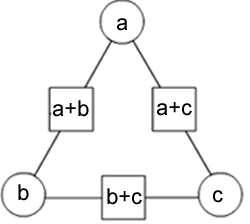
You can find the numbers being represented by $a$, $b$ or $c$ if
you have numbers in the squares.
We will show this by finding b using an example found on the
website:
Using the equation $(b + a) + (b + c) = 2b + a + c $
you can take away $a$ and $c$ to find $2b$:
$(2b + a + c) - (a + c) = 2b $
So $(b + a) + (b + c) - (a + c) = 2b $
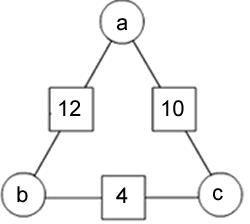
$2b = 12 + 4 - 10 = 6 $
$b = 3 $
This also works with negative numbers.
Robert from Leventhorpe School used a similar
analysis:
To work out the formula for working out these arithmagons, we must
first substitute the numbers as such:
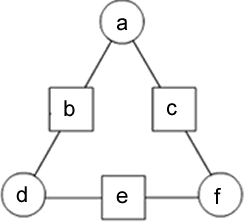
If we know $b, c$ and $e$, then we can say that
$a + d = b$,
$d + f = e$ and
$a + f = c$
In the first one, $b = 12, c =10$ and $e = 4$,
so $a + d = 12$, $d + f = 4$ and $a + f = 10$
If we then add all of these together,
we get $(a+d) + (d+f) + (a+f) = 12 + 4 + 10 $
We do not need the brackets,
so we can make it $a + d + d + f + a + f = 26 $
This can be cancelled down to $2a + 2d + 2f = 26 $
If we then divide everything by $2$ we get $a + d + f = 13$.
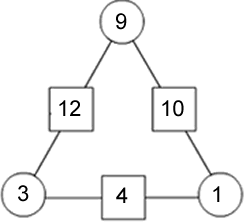
Because we know that $a + d = 12$, $f$ must be $1$.
Since $d + f = 4$, $d$ must be $3$.
Finally, we can say that a must be $9$.
Double checking this, it works. Take a look:
Tom from Colyton Grammar School also
used some algebraic thinking to analyse the problem:
If the circles were $z, y$ and $x$ from the top clockwise and
the squares are $q, r$ and $p$ from the left clockwise then
$x + z = q$,
$z + y = r$
and $x + y = p$.
$q - r = x - y$
so $q + p - r = 2x$
so $x = (q + p - r) / 2$.
This means that $y = ( p + r - q ) / 2$
and $z = (q + r - p) / 2$, by symmetry.
Shaun from Nottingham High School came to the
same conclusion:
It struck me this problem would be most easily investigated
using simultaneous equations as a means of deriving a common rule
for all arithmagons.
I will call the three circles of the arithmagon $a, d$ and
$f$.
Hence, each squares can be expressed as the sum of two of the
variables.
Since we have three variables, and three equations involving
two of them each, we know it can be solved this way.
Some preliminary doodlings proved this to be true.
Let the squares be defined as follows:
(1) $a + d = b$
(2) $d + f = e$
(3) $f + a = c$
Therefore:
(4) $b + f = c + d$
(5) $b + f = e + a$
(6) $e + a = c + d$
From (4): $f = d + c - b$
Combining this result and (2):
$e - d = d + c - b$
$2d = e - c + b$
$d = (b + e - c)/2$
And so, using this formula, the value in a circle, when the
three squares in the arithmagon are known, can be found.
Of course, the variable $b$ can be used to denote any of the
three circles, and $x$ and $y$ the adjacent squares (does not
matter which), and $z$ the opposite.
Following these rules, the formula can also be written
as:
$a = (b + c - e) / 2$
$c = (c + e - b) / 2$
I think the process I have gone through above explains why all
arithmagons can be completed - they all exhibit these attributes,
and so can all be solved in the same way.
Well done to you all, and to Leighton, Jeremy,
Lindsay and Bhavik who also sent us very good solutions.