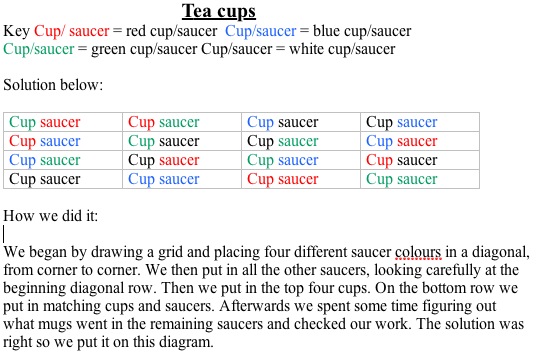
Tea Cups
When I want to create a solution and I may have forgotten one then
I work on it in the following way;
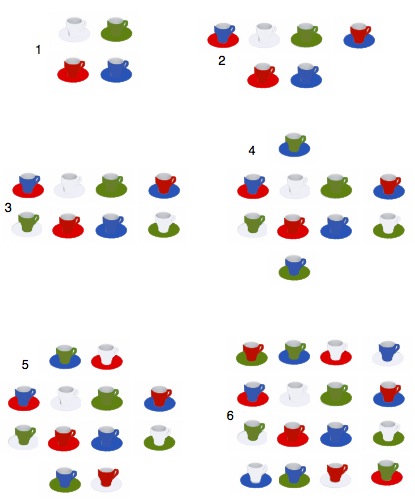
I place the four "doubles" in a square to br the middle [diag 1].
East and West of the top two must be red/blue and blue/red so Ihave
a 50% chance of being correct [diag 2] East and West of the lower
pair must be white/green and green/white [diag 3] I then do the
North and South of the left two of the original square, these must
be blue/green and green/blue [diag 4] Similarly for the right hand
side [diag 5] This just leaves the four corners and that's very
easy [diag 6].
The very quick solution that Sarah found
satisfied her a lot. She used some bits of coloured papers, and
used the four doubles across the top to start off.
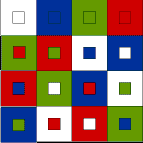
She noticed how each of the four corner
arrangements of four contained one of each colour for both the cups
and the saucers. She also had managed to achieve differences
throughout the diagonals as well, although that was not asked
for.
This led me to look more closely:-
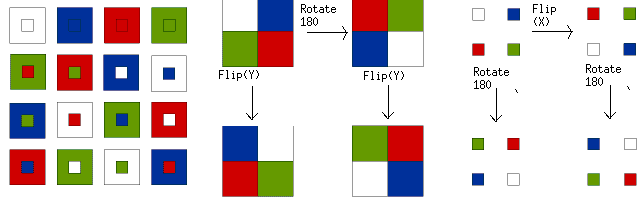
Here I copied Sarah's top left hand corner
four, but I slightly changed the top right hand four saucers so
that the clockwise order of saucers [ white, blue, red & green]
should remain the same, and the arrangement was just a rotation of
180'. The bottom left hand four then turned out to be a flip [along
the y axis] from the top left hand four. The bottom right hand then
came from either rotating the bottom left hand four OR flipping the
top right hand four . These were the saucers sorted out and the
cups worked in a similar way but with the transformations swopped
over, as shown in the diagramme.
Many youngsters have produced a result like
this :-
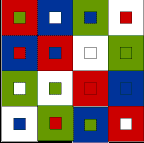
Here the diagonals are of one saucer colour
each. It is a good solution to look at as it has some interesting
patterns in it.
Many youngsters have gone on to have a look at
different numbers of cups and saucers.
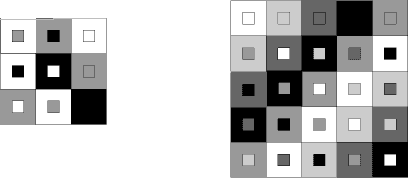
Some new patterns
can be seen when you look at these arrangements that have an odd
number of sets of coloured cups and saucers.
When I want to create a solution and I may have forgotten one
then I work on it in the following way;
SOLUTIONS PRIOR TO FEB 2011
Well done all of you who sent in
these solutions. I am very pleased with the ways that you went
about doing this challenge and the different ways you showed your
results.
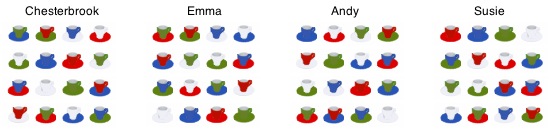
Pupils from Chesterbrook Academy
sent in this:
We first started off by doing column
by column and row by row. After we found out it would take us
forever, we tried putting the doubles (green green, blue blue,
etc.) in the middle four squares. This idea was given to us by our
teacher, Mrs. Johnson. After that, we built off the centre. Our
answers were:
First row
g r b w
b g w r
Second row
w b r g
g b r w
Third row
b w g r
r w g b
Fourth row
r g w b
w r b g
Then someone else from the same
school added:
We figured it out by putting the
doubles (white, white, green, green etc.) in the middle. Then we
put the ones that were opposites together and took each column too
see if the patterns could go there. If it didn't work we switched
the middle until we finally got it.
Here's Emma's Solution that she sent
in in a doc.form:
Andy sent in the following. I liked
his method for finding a solution by starting with the special
diagonal and then filling in. I've not come across this method
before. This solution has the added attraction (perhaps difficulty)
that the diagonals also have to obey the rule!
The answer is
BB WR GW RG
RW GG WB BR
WG BW RR GB
GR RB BG WW
B stands for blue
G stands for green
R stands for red
W stands for white
The first letter of each double is
the saucer
The second letter of each double is
the cup
First we have to put the cups and
saucers that are the same colour in a diagonal line. Then we work
out the rest of the space by using the diagonal.
Eg BB GG
The space between BB and GG will be
filled with RW and the opposite space would be filled with WR. In
the end all the space would be filled in the the shape of a square
and that is the answer.
Susie sent in these comments
accompanied by the Spreadsheet. This is the first time, out of
hundreds of times, that I've been presented with this method of
finding a solution. Well done Susie (from Cathedral School - I
wonder which one?).
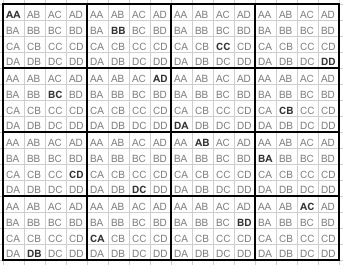
I made a 4 by 4 square and wrote in
each square pairs of letters AA, AB, AC to mean the colours of cups
and saucers. I used Excel.
To select a cup and saucer I
coloured the letters black and crossed the same thing off in all
the other squares. If the thing I chose was AB then I would also
cross off the A-somethings from same line and row, and I would also
cross off the something-Bs from same line and row. I started off by
putting AA, BB, CC and DD on the top row. I wanted a diagonal going
down right of A-somethings and a diagonal going down left of
D-somethings. In one square I had the choice of DA or DB so I chose
one and carried on. I noticed a pattern of 2 short diagonals of
C-somethings and B-somethings appearing. My dad helpd me with the
spredsheet and with this email.
The four solutions could be viewed as:-