Sarah's written:-
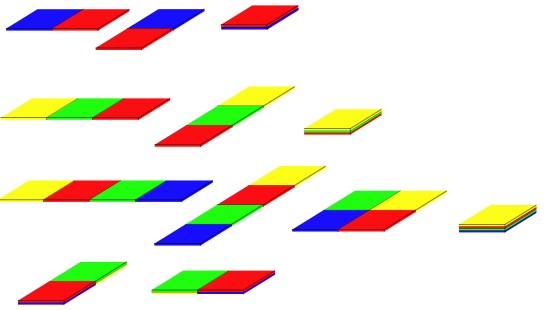
Arranging a cuboid is based on making the number by multiplying three numbers together as the three sides of the cuboid: length, breadth and height.
I carried out the investigation for up to 12 cassette boxes and compared the results to the possible ways of making the number:-
| Number of Boxes | Ways of Making Number | No. of Cuboids |
|---|---|---|
| 1 | 1x1x1 | 1 |
| 2 | 1x1x2 | 3 |
| 3 | 1x1x3 | 3 |
| 4 | 1x1x4, 1x2x2 | 6 |
| 5 | 1x1x5 | 3 |
| 6 | 1x1x6, 1x2x3 | 9 |
| 7 | 1x1x7 | 3 |
| 8 | 1x1x8, 1x2x4, 2x2x2 | 10 |
| 9 | 1x1x9, 1x3x3 | 6 |
| 10 | 1x1x10, 1x2x5 | 9 |
| 11 | 1x1x11 | 3 |
| 12 | 1x1x12, 1x2x6, 1x3x4, 2x2x3 | 18 |
For each way of making the number with three different numbers (AxBxC) there are six possible ways of arranging the boxes as a cuboid (AxBxC, AxCxB, BxAxC, BxCxA, CxAxB, CxBxA). For each way of making the number with two different numbers and the third number the same as one of the previous numbers (AxAxB) there are 3 different ways of arranging the boxes (AxAxB, AxBxA, BxAxA). For each way of arranging the boxes by cubing one number (AxAxA) there is just one way of arranging the boxes (AxAxA).
For example, 8 can be made as 1x1x8, 1x2x4 and 2x2x2. The first way is AxAxB so the cuboid can be made in three ways. The second is AxBxC so this cuboid can be arranged in six ways. The third is AxAxA and can only be arranged in one way. The total of these is 10 cuboids for 8 cassettes.
This will work for any number of cassettes. Prime numbers will always have 3 arrangements because the only way of making the number is by multiplying itself by one twice and so it is AxAxB.
Well Done Sarah!
From John in West Flegg we have:-
When I started with four boxes I found four solutions so I started thinking that the number of boxes you had was the number of solutions there was,

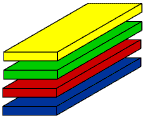

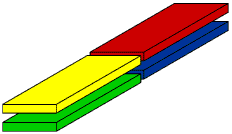
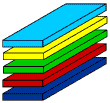
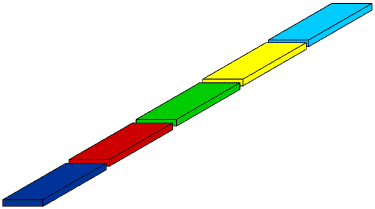

After doing this with five boxes I started to think the same as I did with four boxes except that on odd numbers it was three solutions.
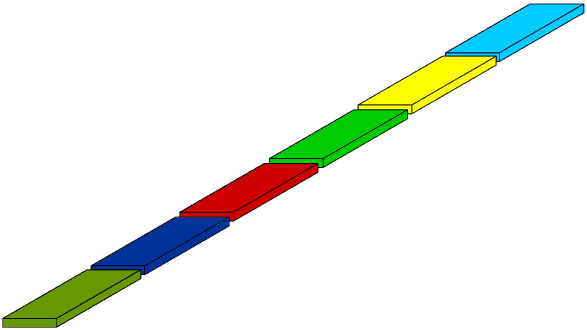
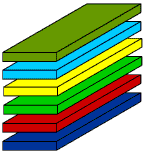

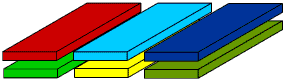
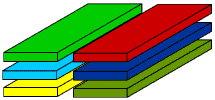
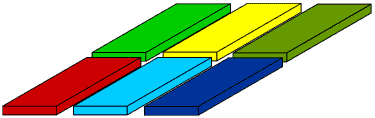
After doing this I think that my thoughts for five boxes were correct.''