Fault-free Rectangles
Sammy and George from Ardingly, and Bilge, age 12 all sent in correct answers to the first part of the question.
As George explains:
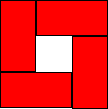
A rectangle doesn't necessarily have to be a oblong it can be a square. All you have to do is build a fault free square which is easy:
You have to put the white square in the middle and then place the red oblongs (so that there are no faults) around the edge of it.
The fault-free rectangle looks like this:
Congratulations to V. Abhijit, age 15 who sent in a fuller solution:
The key behind making a fault free rectangle is this:
Start with a 1 by 1 rectangle, place it at the centre
Now, place 4 2 by 1 rectangles around the 1 by 1 rectangle This will form a fault free rectangle(actually a square, but nevertheless its a rectangle!!)
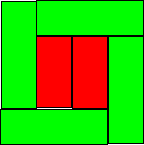
Thus if you start with a 2 by 1 rectangle, place 2 of them at the centre and then place 4 3 by 1 rectangles around the initial arrangement.
This rectangle is the one made by the red and green rods:
V. Abhijit goes on to generalise...
I noticed that you get a fault free rectangle when I used an "N by 1" rectangle along with an "N+1 by 1" rectangle. I had to put N "N by 1" rectangles at the centre (that forms a square) and then had to place 4 "N+1 by 1" rectangles around the arrangement to get a fault free rectangle(that turned out to be a square)
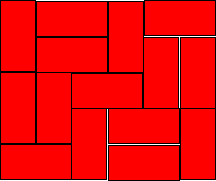
V. Abhijit gives the smallest fault-free rectangle that can be made using 2 by 1 rectangles as that shown below:
Can you find another?