Tables Without Tens
Why do this problem?
This problem involves learners in making and proving conjectures using patterned numbers and arithmetic sequences. It is, incidentally, a very interesting way of revising multiplication tables! It is also very useful for getting learners to predict what they think they will find out.
This is a good class investigation in that it can be taken on a long way but patterns can be found at an early stage so those who work more slowly will be doing some discovering.
Possible approach
You could introduce the investigation as suggested or, alternatively, from a standard $10 \times 10$ 'table-square' simply dropping the tens. However, this does remove some of the exploration and discovery.
After the initial introduction learners could work in pairs so that they are able to talk through their ideas with a partner. Plenty of squared and plain paper should be available. Squared paper can be found
here.
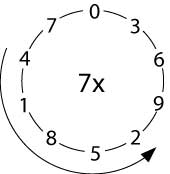
You could show the group the cycles of repeats which are a very useful way of recording but learners may find another better way! When making them, make sure that the arrows are put in because this matters.
They can be put in like this:
�
At the end of the lesson the group should come together to discuss their explorations and discoveries. The factors of $10$ and the complements in $10$ (the numbers that add to make $10$) should arise in interesting ways. When pressed, can they give satisfactory explanations?
Key questions
What do you think you will find out from doing this?
How often does it repeat?
Which digits are there in the line?
Have you looked along the rows and up and down the columns?
Have you looked at any of the diagonals?
Would it help, when you're finding repeats, to extend the rows to $11$ lots of the number, $12$ lots, $13$ lots?
How did you make each row in the first place?
Possible extension
After exploring the many patterns in the investigation given learners could try
Diagonal Sums.
Some ideas for more extensions can be found on
this sheet.
Possible support
Suggest using a standard $10 \times 10$ 'table-square' to help with the tables. If even this is proving difficult, start by using a $10 \times 10$ 'table-square' [such as this one] that can be written on and crossing out the tens figures. The resulting unit-numbers can then be transferred to a plain sheet of squared paper. This ready-made sheet might help.