Sizing Them Up
Sizing Them Up
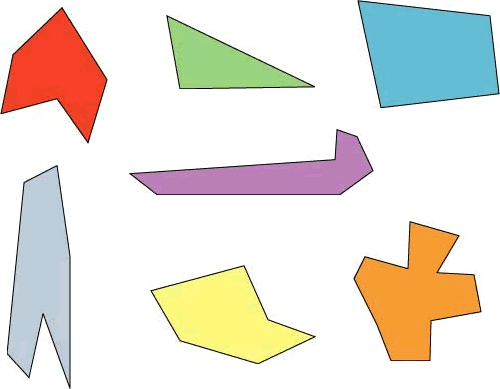
Arrange these shapes in order of size. Put the smallest first.
You might like to use this interactivity to try out your ideas:
Full screen version
This text is usually replaced by the Flash movie.
Why do this problem?
This activity is designed to help children begin to understand the meaning of area as a measurement of surface. It gives them a chance to choose and then justify a way of measuring.
Possible approach
This activity is deliberately open to encourage children to try to define "smallest" for themselves. At this level, the important point is to be able to explain and justify a particular order, rather than there being any right or wrong way to do it. Children might use criteria such as length, height or perimeter, for example. The activity should lead into the introduction of the concept of
area, (even if the word "area" itself is not used).
You could start the activity off with a few shapes which are obviously very different "sizes" so that children will agree on an order. Invite them to explain why they ordered them in that way. After this you could use the interactivity on an interactive whiteboard to introduce the shapes in the problem or simply show them the shapes cut out from
this sheet . After this, children could work in pairs with the shapes. Tell them that this will be harder to do than it was with the first shapes they looked at. It is important to allow plenty of time for children to share their ordering and explanations with their partners and the rest of the group.
There is no reason why you should not make your own irregular shapes using the activity as an idea rather than a problem to be solved.
Key questions
Why do you think this shape is bigger/smaller?
How are you going to decide which is smallest?
Possible extension
Children could be asked cut out shapes which they think are "the same size" but which are very different shapes from those given.
Possible support
Some children might benefit from cutting out the shapes from this sheet and putting them one on top of another to aid comparison.