Coordinate Challenge
Here is a grid:
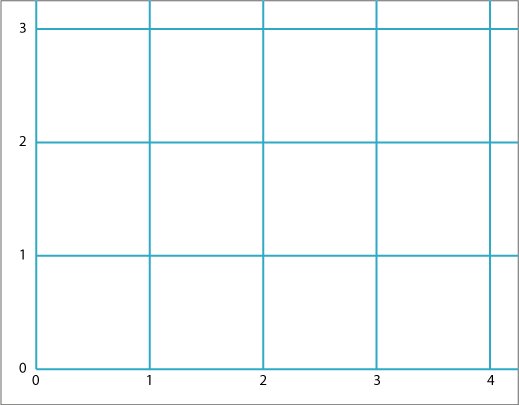
Can you position these ten letters in their correct places according to the eight clues below?
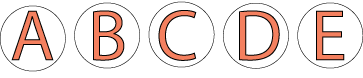

Clues:
The letters at $(1, 1),$ $(1, 2)$ and $(1, 3)$ are all symmetrical about a vertical line.
The letter at $(4, 2)$ is not symmetrical in any way.
The letters at $(1, 1),$ $(2, 1)$ and $(3, 1)$ are symmetrical about a horizontal line.
The letters at $(0, 2),$ $(2, 0)$ have rotational symmetry.
The letter at $(3, 1)$ consists of just straight lines.
The letters at $(3, 3)$ and $(2, 0)$ consist of just curved lines.
The letters at $(3, 3),$ $(3, 2)$ and $(3, 1)$ are consecutive in the alphabet.
The letters at $(0, 2)$ and $(1, 2)$ are at the two ends of the alphabet.
You could use this interactivity to try out your ideas.
Full Screen Version
This text is usually replaced by the Flash movie.
It would be good to have the problem displayed on an interactive whiteboard or data projector so that you can use the interactivity throughout the lesson. Start by arranging some of the letters on the grid and asking the children a few questions about where they are placed which will remind them about symmetry and coordinates. For example, you could ask "Where is the letter that has two
lines of symmetry?"; "What do all the letters at ... have in common?".
After this learners could work in pairs on the problem so that they are able to talk through their ideas with a partner. They could either use the interactivity at computers or
this sheet which has letters that can be cut out and moved around. Alternatively, the problem could be copied on to squared paper and the letters drawn on in pencil so that they
can be altered easily.
If pupils do not have much experience of dealing with clues and prioritising their order as this problem requires, it might be appropriate to read each clue in turn as a whole group before working on the task in pairs. This way, you can reassure the learners that it doesn't matter if you cannot immediately use a clue to place a letter definitively. You can also demonstrate that having the
letters to move around, or writing them on the grid in pencil, means that the solution can be refined as more information is revealed.